



Alpha Biocare Implants: A Clinician's Guide
Predictability is paramount in implant placement. Clinicians require a system that performs consistently across a broad spectrum of clinical situations. This principle is the foundation of Alpha Biocare implants, engineered to deliver excellent primary stability and streamline the entire surgical and prosthetic workflow.
This practical, evidence-based approach has earned the trust of dental professionals and distributors globally, making it a reliable choice for modern implant dentistry.
The Alpha Biocare Implant Philosophy Explained
In implant dentistry, clinical decisions must be based on reliability. Both clinicians and the distributors who supply them need systems that perform dependably, not just in straightforward cases but also in complex clinical scenarios.
The core philosophy behind Alpha Biocare is a focus on the fundamental principles that ensure long-term patient success. Instead of pursuing fleeting trends, the design prioritizes solid engineering and biological principles that directly impact clinical outcomes. Every component serves a distinct, evidence-based purpose.
This commitment translates into an implant system that simplifies complex procedures without compromising quality or versatility. It is built on three key pillars.
Core Principles of the System
-
Achieving Primary Stability: An implant’s initial mechanical stability in bone is non-negotiable. The macro-geometry of an Alpha Biocare implant—its specific taper and thread design—is engineered for secure fixation upon placement. This mechanical stability provides the foundation for predictable osseointegration and is critical for immediate loading protocols. We have explored this in our analysis of achieving primary stability.
-
Promoting Rapid Osseointegration: Beyond mechanical grip, the implant surface is treated to stimulate a rapid and robust biological response. By creating a specific micro-topography, the surface actively encourages osteoblast attachment, accelerating the formation of a strong bone-to-implant connection.
-
Ensuring Prosthetic Simplicity and Versatility: An excellent implant is only as good as its restorative process. The system is designed to support a straightforward and flexible prosthetic workflow, offering a complete suite of components for single crowns, bridges, and complex full-arch cases. Every element is designed to be intuitive for the restorative dentist.
This focus on fundamentals is why alpha biocare implants are a trusted solution in practices worldwide. These are not just components; they are complete, integrated systems where every element, from the surgical drill to the final abutment, is designed for seamless compatibility. To see the full range, you can explore our main implant product page.
Distributors seeking to partner with a brand committed to clinical excellence and reliability are invited to become a distributor and join our growing global network.
The Engineering Behind Clinical Stability
An implant's success is determined the moment it engages with bone. The design is a sophisticated application of mechanical principles that directly impacts immediate performance and long-term patient outcomes. With Alpha Biocare implants, every thread, taper, and apical feature is engineered with one primary goal: achieving immediate, robust mechanical stability.
This initial grip, known as primary stability, is the bedrock upon which successful osseointegration is built. It is essential for preventing micromovements that can compromise healing, making it a critical factor for predictable outcomes, especially in immediate loading protocols. The system’s design philosophy is not about removing bone but intelligently condensing it.
A practical example is the difference between a standard drill bit and a self-tapping screw. A drill bit removes material, potentially weakening the surrounding structure. A self-tapping screw displaces and compacts the material, creating a more secure fit. Alpha Biocare’s thread design works on a similar principle, gently condensing bone to maximize bone-to-implant contact from the moment of placement.
The Role of Body Morphology and Thread Design
The overall shape, or morphology, of an Alpha Biocare implant is engineered for controlled placement and optimal stress distribution. Its tapered body facilitates gradual bone compression during insertion, which is a significant advantage in softer bone types (D3/D4), where achieving high insertion torque can be challenging.
This is complemented by a deep, sharp thread profile. These threads actively engage the bone, dramatically increasing the implant's surface area and mechanical interlocking.
Key design elements include:
- Tapered Core: Simplifies insertion and allows the clinician to modulate stability by adjusting the drilling protocol.
- Double-Lead Threads: This feature accelerates the insertion process, reducing chair time and potential trauma to the bone.
- Apical Cutting Flutes: While the main body condenses bone, the sharp apical end is self-tapping, ensuring a precise and predictable insertion path, even in denser bone.
By combining bone condensation with self-tapping features, the implant achieves a powerful biomechanical lock. This hybrid approach delivers the versatility needed for high primary stability across a spectrum of bone densities and clinical scenarios.
This infographic illustrates the connection between Alpha Biocare's core philosophy, clinical efficiency, and patient success.

It is a clear visual representation of how thoughtful engineering leads directly to smoother procedures and predictable, positive outcomes.
Achieving Predictability in Diverse Clinical Conditions
The demand for reliable and advanced implant solutions continues to grow. For example, the European dental implant market dynamics on mordorintelligence.com show significant expansion. In such a competitive environment, implant systems must perform consistently across all clinical situations.
The engineering behind Alpha Biocare implants is designed to meet this challenge. In an immediate extraction socket, for instance, the aggressive threads engage the remaining socket walls to secure the implant, while the tapered body helps fill the void and promote new bone formation. For clinicians interested in these mechanics, we offer a detailed analysis of primary stability in immediate versus delayed loading protocols.
This deliberate design approach provides clinicians the confidence to manage a broad range of cases, knowing the implant itself is engineered to establish a secure foundation for long-term success.
The Surface Science Behind Predictable Osseointegration
While an implant’s macro-geometry is key for initial mechanical stability, its long-term success depends on interactions at the microscopic level. The surface of an Alpha Biocare implant is an engineered interface, meticulously designed to actively promote bone-forming cell activity. This focus on surface science facilitates predictable and accelerated osseointegration.
It begins with the material: Grade 5 titanium alloy (Ti-6Al-4V), known for its excellent biocompatibility and mechanical strength. However, a smooth, untreated titanium surface is not optimal for promoting osteogenesis. To enhance performance, the surface must be modified to create a specific topography that bone cells can recognize and adhere to.
This is where Alpha Biocare's multi-stage surface treatment process is crucial. It transforms the implant from a passive device into an active participant in the patient's healing process.
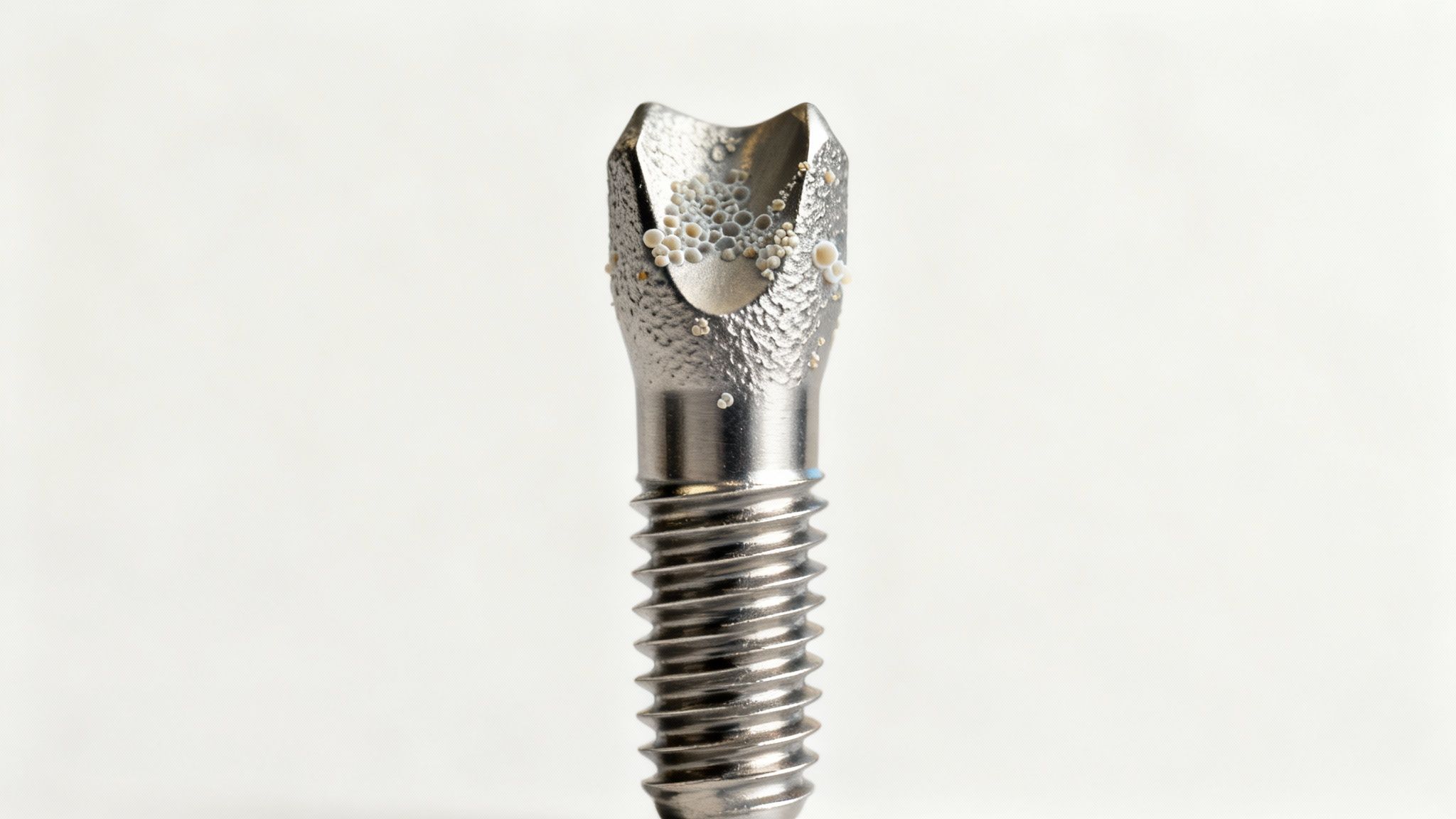
Creating a Microrough Landscape for Bone Cells
The objective of the surface treatment is to engineer a complex, microrough topography. Osteoblasts—the cells responsible for bone formation—require a textured surface to anchor and proliferate. A microrough surface provides this, dramatically increasing the available area for cell attachment.
This larger surface area directly improves the Bone-to-Implant Contact (BIC) percentage. A higher BIC signifies a stronger, more stable fusion between the implant and jawbone, which is the definition of successful osseointegration.
The treatment involves several critical steps:
- Grit-Blasting: The implant surface is blasted with biocompatible ceramic particles to create an initial layer of macroroughness.
- Acid-Etching: Following blasting, the implant is treated with an acid-etching bath. This superimposes a finer micro-pitting pattern onto the larger texture, creating a complex, multi-level landscape.
- Intensive Cleaning: The implant undergoes a rigorous cleaning and sterilization process to remove any residual particles, resulting in a pure and highly reactive titanium surface.
This combination of grit-blasting and acid-etching creates a moderately rough surface, which is widely supported by clinical research for promoting rapid and robust osseointegration.
How Surface Science Translates to Better Clinical Outcomes
For the clinician and patient, this meticulous surface engineering leads to a more predictable and often shorter healing period. The hydrophilic nature of the treated surface actively attracts blood and its associated growth factors upon placement.
This bio-activation is the critical first step. It initiates the biological healing cascade, leading to faster fibrin clot formation and encouraging the migration of osteogenic cells to the implant site.
This benefit is particularly evident in demanding clinical situations, such as immediate placement protocols or cases involving compromised bone quality. The enhanced cellular response provides a greater margin for success and a more reliable foundation for the final restoration. For a deeper dive, you can explore the science behind dental implant surfaces and its direct effect on healing.
The surface of an Alpha Biocare implant is designed to minimize clinical variables. By optimizing the interaction between the implant and the body’s healing mechanisms, the system delivers a predictable path to successful, long-term osseointegration—the cornerstone of modern implant dentistry.
Mastering the Surgical and Prosthetic Workflow
An implant system's value is measured by its seamless integration into daily clinical practice. Alpha Biocare implants are engineered to provide a clear, predictable workflow from surgical placement to final restoration, reducing chair time and enhancing collaboration between the surgeon and restorative dentist.
The process begins with precise treatment planning. Whether using traditional models or a fully digital approach, establishing the ideal implant position is the essential first step. The Alpha Biocare surgical kit is logically designed to execute this plan with high precision.
The Surgical Phase: A Protocol Built for Precision
The surgical protocol for Alpha Biocare is straightforward and designed to deliver predictable results across varying bone densities. The drills are colour-coded and arranged in a logical sequence corresponding to the implant diameter, a simple visual cue that minimizes errors and ensures the osteotomy is prepared to exact dimensions.
The drilling sequence is designed to be minimally traumatic. Sharp, high-quality drills create a precise osteotomy with minimal heat generation, which is critical for preserving bone cell viability and promoting healthy osseointegration. The final drill matches the implant body, ensuring the snug fit required for high primary stability.
Key features of the surgical workflow include:
- Colour-Coded Instruments: Drills, taps, and implant drivers are clearly marked to match specific implant diameters, simplifying the procedure.
- Depth Markings: Laser-etched markings on the drills provide clear visual cues for achieving the planned implant depth accurately.
- Versatile Drill Design: The drills are effective in a range of bone types, from soft D4 to dense D1, allowing for a consistent protocol.
This structured approach provides confidence during surgery. The tactile feedback during implant insertion, combined with the system's design, allows for precise control over final placement and insertion torque—a key indicator of primary stability. For clinicians advancing to digital protocols, learn how Alfa Gate supports a complete digital workflow for guided surgery.
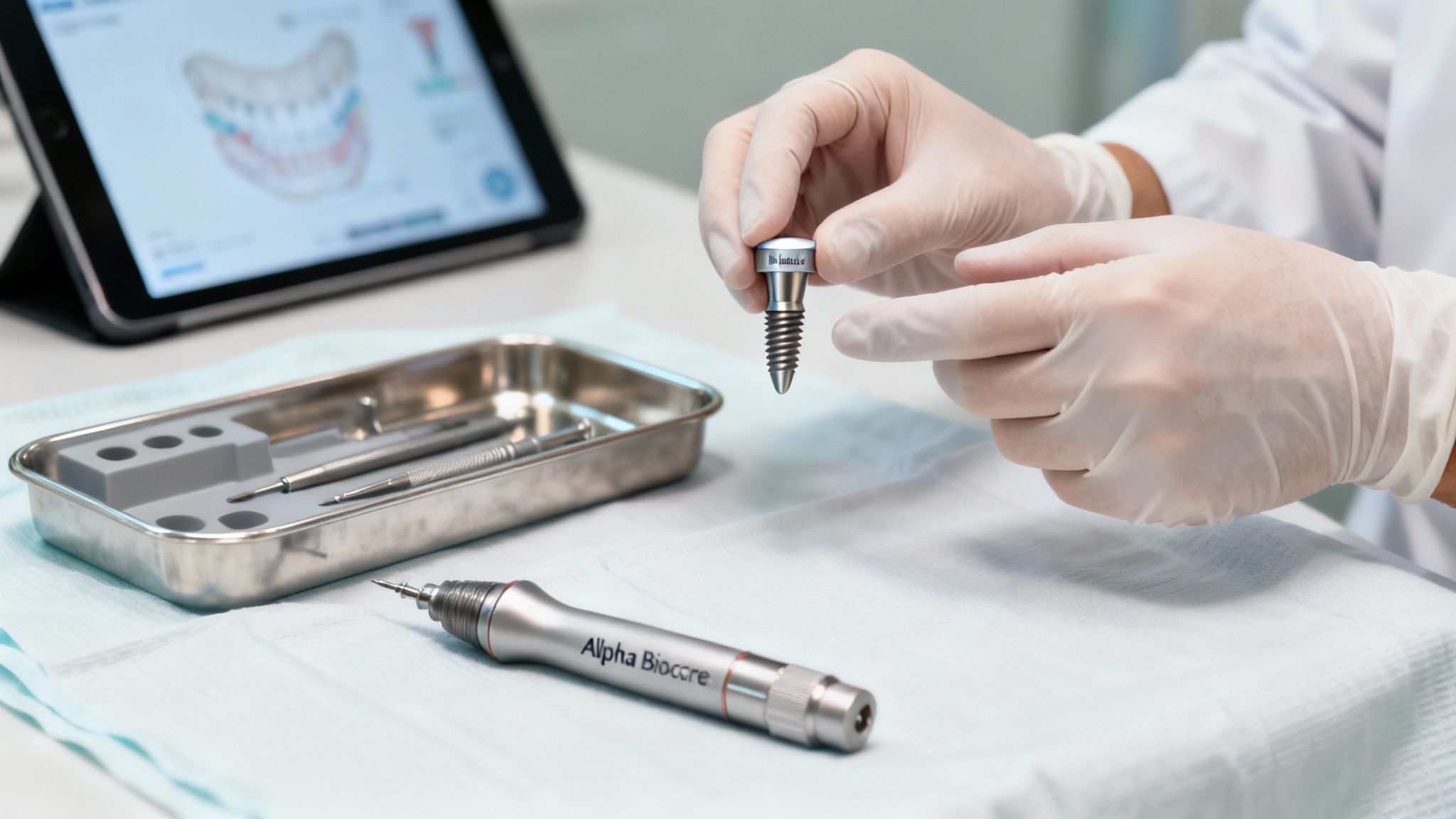
The Prosthetic Phase: Versatility and Simplicity
After osseointegration, the workflow transitions to the prosthetic phase. Alfa Gate provides a full suite of restorative components compatible with both conventional and digital impression techniques, offering practices necessary flexibility. This versatility is essential for managing the wide range of clinical scenarios, from single crowns to full-arch rehabilitations.
For conventional workflows, clinicians can choose between open-tray and closed-tray impression copings. These components are designed to accurately transfer the implant’s position and orientation to the dental laboratory.
Digital workflows are equally supported. The system includes precision-manufactured scan bodies that capture the implant's exact location in a digital impression. This data integrates smoothly with leading CAD/CAM systems, enabling labs to design and mill custom abutments and restorations with exceptional accuracy.
The goal of the prosthetic phase is to deliver a final restoration that is functional, durable, and esthetically pleasing. The system’s prosthetic components are designed to support excellent soft tissue contours and emergence profiles, which is key to achieving natural-looking results.
The wide range of available abutments—including temporary, straight, and angled multi-unit abutments—provides a solution for nearly any restorative challenge. By offering a streamlined path from surgery to restoration, the Alpha Biocare system helps clinicians deliver consistent, high-quality outcomes with greater efficiency.
Expanding Your Clinical Applications
The true measure of an implant system is its versatility in real-world clinical practice. The ability to confidently manage a wide range of scenarios with a single, trusted system is a significant advantage. Alpha Biocare implants are designed with this flexibility in mind, offering reliable solutions from single-tooth replacements to demanding full-arch rehabilitations.
This versatility is a direct result of a portfolio engineered for specific challenges. By strategically matching the right implant to the clinical situation, clinicians can expand the scope of treatments offered to patients.
Immediate Placement in Extraction Sockets
Placing an implant immediately following an extraction can significantly reduce treatment time and help preserve alveolar bone. This procedure requires an implant that achieves high primary stability in a compromised site.
This is where the aggressive thread design and tapered body of specific Alpha Biocare implants excel. These features are designed to engage the remaining socket walls, establishing the crucial mechanical lock needed for predictable osseointegration. The self-tapping apex guides the implant precisely, while the body condenses the surrounding bone to enhance the initial grip.
Sinus Augmentation and Soft Bone Scenarios
The posterior maxilla often presents challenges of limited bone height and softer D3/D4 bone quality. When a sinus lift is indicated, the implant placement must be atraumatic to the graft.
For these cases, an implant designed for bone condensation is ideal. Instead of removing bone, it compacts the porous trabecular bone, increasing its density around the implant threads. This approach helps secure the implant firmly without risking the sinus membrane or displacing graft material, resulting in a stable foundation in a challenging anatomical area.
Full-Arch Rehabilitations
Full-arch fixed restorations, such as "All-on-4" or "All-on-6" protocols, rely on strategic implant placement to support a full-arch prosthesis. This application requires implants that can be placed at specific angles to maximize bone engagement and avoid critical anatomical structures.
The Alpha Biocare implants system, with its comprehensive range of angled multi-unit abutments, is a dependable choice for these transformative cases. The high primary stability achieved often allows for immediate loading, enabling patients to receive a fixed provisional restoration shortly after surgery.
Understanding the unique strengths of each implant design allows for a departure from a one-size-fits-all approach. Strategic case selection leads to more predictable outcomes, even when facing anatomical limitations or high patient expectations.
This adaptability allows clinicians to meet diverse patient needs without compromising performance. For distributors and dental professionals looking to learn more, we invite you to Contact us today to discuss your clinical needs or explore our full range of implant and prosthetic solutions.
Your Questions Answered
We receive many excellent questions from clinical partners and distributors. Here are answers to some of the most common inquiries to help you make informed decisions for your practice.
Are Alpha Biocare Prosthetic Components Cross-Compatible?
The definitive answer is no. While other systems may have connections that appear similar, we strongly advise against mixing and matching components.
Alpha Biocare implants and their corresponding prosthetic parts are engineered as a single, cohesive system with components machined to precise tolerances. Introducing a non-original part can create micro-gaps that compromise the entire restoration.
Potential long-term complications include:
- Screw Loosening: An imperfect fit creates uneven forces on the abutment screw, increasing the likelihood of loosening over time.
- Microbial Leakage: Microscopic gaps can harbor bacteria, increasing the risk of peri-implantitis at the implant-abutment interface.
- Component Fracture: Mismatched parts do not distribute occlusal forces as designed, which can lead to screw or abutment fracture.
To ensure predictable, lasting results and maintain the system's warranty, always use genuine Alfa Gate prosthetic components. Our portfolio, including the versatile M+ Conical Connection abutments, is designed to create a perfect, sealed connection.
What Is the Scientific Evidence for the Implant Surface?
The surface of Alpha Biocare implants is supported by extensive preclinical and clinical research. The moderately rough surface, achieved through a specific grit-blasting and acid-etching process, is one of the most well-documented and successful topographies in implant dentistry.
Decades of studies have shown that this type of surface significantly outperforms older, machined surfaces in promoting osseointegration. It creates an ideal microscopic landscape for osteoblasts to adhere, proliferate, and synthesize new bone, resulting in a higher percentage of direct Bone-to-Implant Contact (BIC).
The objective is not to passively wait for bone healing but to create a bioactive interface that actively accelerates the body's natural processes. The optimized micro-topography promotes faster, stronger bone formation directly on the implant surface, which is key to achieving robust secondary stability.
This accelerated healing is particularly beneficial in challenging scenarios like immediate loading or placement in compromised bone. For a deeper analysis of the science, our article on the biology behind modern implant surfaces is an excellent resource.
What Training and Support Resources Are Available?
Alfa Gate is committed to empowering clinicians with the knowledge and support needed to achieve optimal outcomes. We and our global distributors offer a comprehensive suite of educational resources designed to facilitate seamless system integration.
Our support includes:
- Product Specialists: Our experts are available for technical inquiries, product details, and case planning assistance.
- Educational Courses and Webinars: We offer regular hands-on courses and online events covering topics from basic surgical protocols to advanced digital workflows.
- Clinical Literature: Access a full library of clinical studies, case reports, and technical manuals to support an evidence-based practice.
- In-Office Support: Our local partners can provide hands-on assistance for clinicians new to the system, guiding teams through initial cases.
Our goal is to be a true clinical partner. For potential distributors who share this philosophy, we encourage you to learn about our partnership program and become a distributor.
Conclusion: Your Next Steps
This guide has covered the engineering principles, surface science, and clinical workflows that define Alpha Biocare implants. The system's deliberate design translates directly into predictable stability and successful long-term outcomes in clinical practice.
Ultimately, implant dentistry demands a system you can trust. Whether managing a single-tooth replacement or a complex full-arch reconstruction, the Alpha Biocare portfolio is built to deliver consistency and efficiency.
If you are ready to explore how these implant systems can integrate into your practice, the next step is to browse our complete line of implant and prosthetic solutions.
For specific questions about a complex case or to discuss distribution opportunities, Get in touch with a product specialist directly. We are here to help you achieve superior patient outcomes.
Ready to integrate a reliable and efficient implant system into your practice? Explore the full range of implant options from Alfa Gate at https://www.alfa-gate.us.