



A Clinician's Guide to the Multi Unit Abutment
A multi-unit abutment (MUA) is a critical component connecting a dental implant to the final prosthesis, particularly in full-arch restorations. It is engineered to correct the angulation of divergently placed implants, creating a unified prosthetic platform for a predictable, passive fit. This technology has become a cornerstone for full-arch implant rehabilitation, enhancing both clinical efficiency and long-term restorative success.
The Foundational Role of the Multi Unit Abutment in Modern Implantology
Achieving perfect parallelism when placing multiple implants across an arch is a significant clinical challenge. The multi-unit abutment addresses this by acting as an intermediary, establishing a level restorative foundation above the gingiva that is independent of the underlying implant angulations. This design elegantly solves the problem of implant divergence.
This correction is essential for ensuring that a large, rigid prosthesis like a full-arch bridge can seat without inducing harmful stress on the implants or prosthetic screws. This is known as a passive fit, a fundamental principle for long-term implant success. Achieving a passive fit helps prevent mechanical complications such as screw loosening or fracture, safeguarding the integrity of the entire restoration.
Simplifying Complex Prosthetic Procedures
The adoption of a multi-unit abutment system simplifies the workflow for the surgeon, restorative dentist, and laboratory technician. Clinicians can prioritize placing implants in the most optimal bone volume, even if this results in varied angulations. The MUA system then compensates for these discrepancies at the prosthetic level.
Key clinical advantages include:
- Correction of Angulation: Angled MUAs can correct implant divergence by up to 30 degrees, creating a common path of insertion. This ensures the final prosthesis can be seated smoothly and without mechanical strain.
- Simplified Impressions: Impressions taken at the abutment level are more straightforward and accurate than implant-level impressions, especially when implants are placed subgingivally.
- Enhanced Retrievability: Screw-retained restorations facilitate easier maintenance. The prosthesis can be removed for cleaning, repairs, or clinical assessments without compromising its integrity.
The MUA transforms a complex restorative challenge into a manageable and predictable workflow. It shifts the prosthetic interface from the implant level to a more accessible supragingival position, improving clinical efficiency and patient outcomes.
To provide a concise overview of the MUA's role, the following table summarizes its core functions.
Multi Unit Abutment at a Glance
| Core Function | Primary Indication | Key Advantage |
|---|---|---|
| To correct implant angulation and create a common restorative platform. | Full-arch or multi-tooth screw-retained restorations (e.g., bridges, hybrids). | Enables a passive fit for the final prosthesis, reducing mechanical stress and improving long-term stability. |
The MUA is an indispensable component in modern implant dentistry, facilitating predictable outcomes in complex cases. High-precision components, such as Alfa Gate multi-unit abutments, are meticulously engineered to provide the stability and flexibility required for demanding restorations. These systems support successful osseointegration and durable prosthetic function.
Clinical Indications for the Multi-Unit Abutment
Understanding the appropriate clinical scenarios for a multi-unit abutment is fundamental to predictable restorative dentistry. The primary indication for an MUA is any multi-implant, screw-retained prosthesis requiring the correction of implant angulation to achieve a passive fit. This makes it an essential component for nearly all full-arch fixed restorations.
In complex rehabilitations like an All-on-4 or All-on-6 protocol, posterior implants are often tilted to engage denser bone, such as in the anterior maxilla or between the mental foramina. This intentional divergence, while surgically advantageous, complicates the restorative phase. The multi-unit abutment system was specifically designed to resolve this issue by creating a common, level prosthetic platform above the soft tissue.
Primary Scenarios for MUAs
The decision to use an MUA is based on the need for a non-engaging, screw-retained framework that connects multiple implants.
- Full-Arch Rehabilitations: This is the primary application for MUAs. Whether planning a fixed hybrid denture or a full zirconia bridge, MUAs simplify the prosthetic process by correcting the angulation of strategically placed implants. For a detailed clinical overview, explore our guide on All-on-4 dental implant procedures.
- Segmented Bridges: For partially edentulous patients requiring a multi-unit fixed bridge, MUAs offer the same advantages. They help manage minor misalignments across a segment of the arch, facilitating a stress-free seating of the prosthesis.
- Immediate Loading Protocols: MUAs are invaluable when planning an immediate provisional prosthesis. They establish a stable, accessible platform on the day of surgery, simplifying the chairside conversion and provisional delivery.
Contraindications to Consider
While versatile, MUAs are not a universal solution. One of the most significant contraindications is insufficient interocclusal space. The MUA, along with the prosthetic components (e.g., titanium cylinder, framework), requires adequate vertical height. A minimum of 10-12 mm of restorative space from the implant platform to the opposing dentition is generally required. Limited space may necessitate an alternative restorative approach.
A common treatment planning error is attempting to use a multi-unit abutment for a single-tooth restoration. MUAs are non-engaging by design, intended for splinted restorations. Using an MUA for a single crown provides no anti-rotational stability, guaranteeing micromovement and eventual screw loosening.
Additionally, extremely deep subgingival implant placement can pose challenges. While MUAs are available in various collar heights, an excessively deep implant can complicate impression-taking and long-term hygiene maintenance, potentially compromising peri-implant tissue health.
Clinical Example: The Maxillary All-on-4
Consider a typical maxillary All-on-4 case. The two anterior implants are placed vertically, while the two posterior implants are tilted distally to avoid the maxillary sinus and engage denser bone.
- Implant Placement: The posterior implants are angled at 30 degrees.
- Abutment Selection: Straight MUAs are selected for the anterior implants. For the posterior sites, 30-degree angled MUAs are used. This corrects the divergence and repositions the screw access channels vertically.
- The Result: All four abutments now present a parallel path of insertion. This allows the full-arch bridge to seat passively and be secured without introducing stress to the implants.
This example highlights how an MUA transforms a complex surgical reality into a straightforward prosthetic solution. Proper case selection is paramount. Should you require assistance in selecting the appropriate components, please do not hesitate to contact our clinical support team.
Straight vs. Angled Abutments: A Decision Framework
Selecting between a straight or an angled multi-unit abutment is a critical treatment planning decision that dictates the final prosthetic outcome. This choice is based on implant position, prosthetic design, and the biomechanical goal of achieving a passive fit.
Straight multi-unit abutments are the default choice when implants are placed in a nearly vertical orientation. They provide the most direct and mechanically sound path for transferring occlusal forces from the prosthesis to the implant. Their simplicity is a key advantage in cases without significant implant angulation.
Angled multi-unit abutments are problem-solvers, essential for most full-arch reconstructions. When implants must be tilted to avoid anatomical structures or engage higher-quality bone, angled MUAs redirect the restorative platform to achieve parallelism. They correct implant divergence, creating a unified path of insertion for the final restoration.
Key Deciding Factors
The choice is determined by the measured angulation of the implant relative to the desired prosthetic screw access channel. This is assessed during digital planning or confirmed clinically with an angulation guide.
- For implants with ≤ 10° of divergence: A straight multi-unit abutment can typically accommodate these minor discrepancies.
- For implants with > 10° of divergence: An angled MUA is required. The most common options, 17° and 30° correction abutments, provide the versatility to manage the vast majority of clinical scenarios.
Access to a comprehensive system with a range of prosthetic options ensures that the ideal component is always available. This is not merely for convenience; it is essential for managing the biomechanics of the restoration correctly.
The Biomechanical Impact of Angulation
The chosen abutment angle directly influences how occlusal forces are distributed through the implant and into the surrounding bone. While angled abutments are a clinical necessity, it is important to consider the mechanical implications. Steeper correction angles can increase stress concentration at the implant neck and on the abutment screw.
Finite element analysis studies have demonstrated this effect. Research has shown that increasing the abutment angle from 17° to 30° can significantly elevate stress on the implant and adjacent bone. This data supports a conservative approach: always select the lowest correction angle that achieves the clinical objective to minimize mechanical strain and reduce long-term risks like screw loosening.
The clinical goal is to use the least amount of angulation necessary to achieve parallelism. If a 17° abutment is sufficient, selecting a 30° abutment introduces unnecessary biomechanical stress into the system. Precision in selection is paramount.
The following table compares the characteristics and ideal applications for straight and angled MUAs.
Comparison of Straight vs Angled Multi-Unit Abutments
This table serves as a quick reference to guide abutment selection based on specific case requirements.
| Parameter | Straight MUA | Angled MUA |
|---|---|---|
| Primary Indication | Implants with minimal angulation (≤ 10°) | Implants with significant angulation (> 10°) |
| Biomechanical Stress | Optimal; direct axial load transfer | Increased; non-axial loads can concentrate stress |
| Common Use Cases | Parallel implant placement in ideal bone volume | Tilted implants (e.g., All-on-4®), avoiding anatomical structures |
| Prosthetic Complexity | Simpler workflow, direct screw access | Requires precise orientation to achieve parallel path of insertion |
| Flexibility | Limited angulation correction | High; corrects significant divergence (e.g., 17°, 30°) |
| Selection Goal | Maintain a direct and simple force pathway | Create a common prosthetic platform from divergent implants |
Ultimately, choosing the right abutment involves balancing the clinical realities of implant placement with ideal prosthetic design principles. For complex case planning and abutment selection support, we invite you to become a distributor.
Mastering the MUA Surgical and Prosthetic Workflow
A successful restoration built on a multi-unit abutment is the outcome of a precise, repeatable clinical workflow. Integrating these components into practice requires a systematic approach covering both surgical and prosthetic phases. A well-defined process ensures efficiency and accuracy for both the clinician and the dental laboratory.
The workflow begins in the operatory following implant placement. The multi-unit abutment can be placed immediately or after initial soft tissue healing. In full-arch, immediate-load cases, placing the MUA at the time of surgery is often preferred, as it establishes the prosthetic platform from day one and simplifies provisional fabrication.
The seating and torque protocol is critical. Each MUA must be threaded onto the implant and tightened to the manufacturer's specified torque—typically between 15-35 Ncm—using a calibrated torque wrench. A radiograph to verify complete seating is mandatory to rule out microgaps between the implant and abutment.
The Prosthetic Phase: Digital and Conventional Paths
Once the MUAs are securely in place, the prosthetic workflow begins. This can be accomplished through either a traditional impression technique or a fully digital workflow.
The conventional method utilizes an open-tray impression. Impression copings are screwed onto each MUA, with long screws accessible through openings in a custom or stock tray. This technique provides the laboratory with a highly accurate physical master cast for fabrication.
For practices equipped with an intraoral scanner, the digital workflow offers a more efficient alternative. MUA-specific scan bodies are attached to the abutments, and a detailed digital impression is captured. This file is then transmitted to the laboratory for CAD/CAM design and manufacturing. For a deeper dive into this process, explore the complete digital workflow with Alfa Gate's system.
The infographic below outlines the decision-making process for abutment selection, the first step in the workflow.
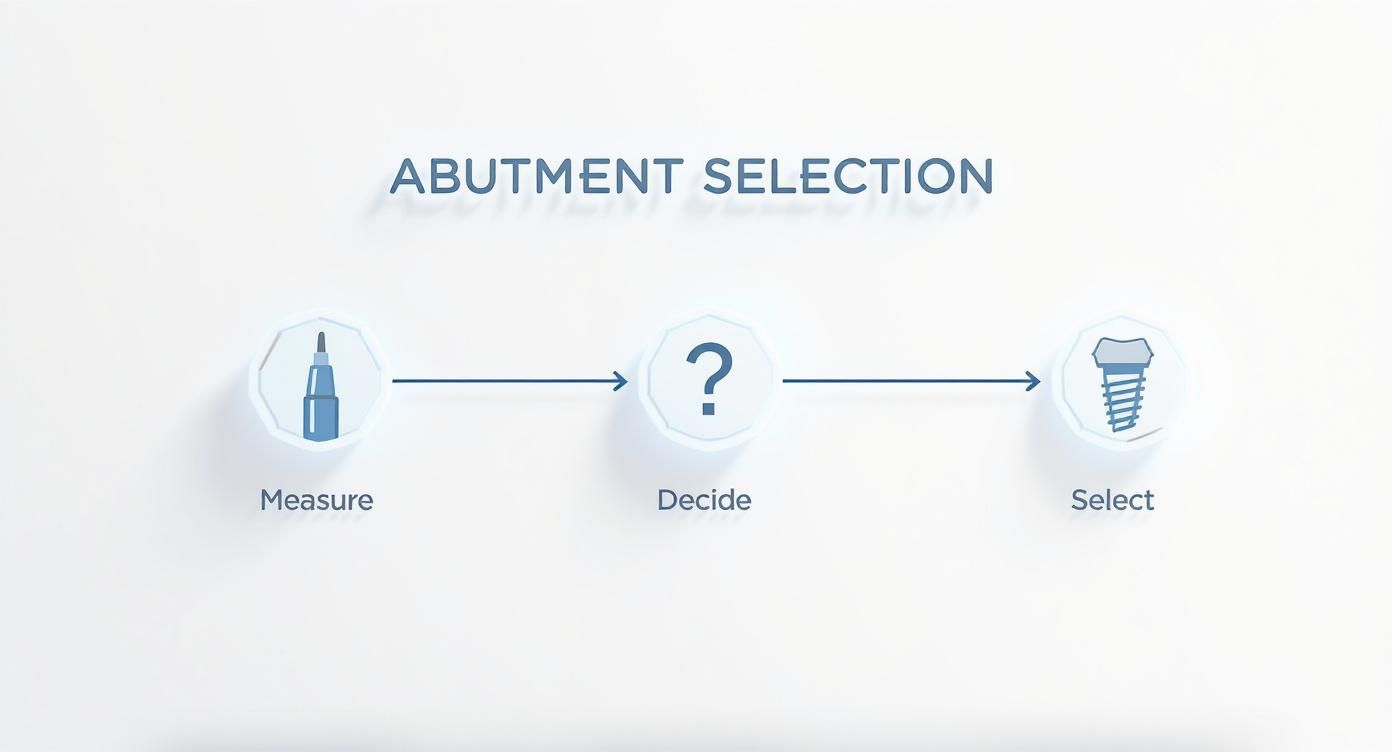
This process simplifies the clinical decision into three core actions: accurately measure the clinical parameters, decide on the prosthetic objective, and select the appropriate component.
Key Considerations for a Passive Prosthetic Fit
Whether using a digital or conventional workflow, the ultimate goal is a prosthesis with a completely passive fit. This means the final bridge seats on the abutments without inducing any tension or stress on the implants.
A passive fit is not a luxury; it is a clinical necessity. Any misfit, however minor, can lead to persistent screw loosening, component fracture, or even biologic complications like bone loss around the implants. Verifying passivity at every stage—from framework try-in to final delivery—is non-negotiable.
Here are practical tips for a successful MUA workflow:
- Surgical Phase Tip: After torquing the MUA, use a periodontal probe to feel the circumference of the connection. This tactile check can help detect a ledge or discrepancy indicating incomplete seating before radiographic confirmation.
- Impression Phase Tip (Conventional): Before loading the impression tray, confirm that all impression coping screws can be easily accessed and turned. Difficulty loosening a screw after the material has set may indicate that the coping shifted, compromising accuracy.
- Scanning Phase Tip (Digital): Capture multiple images from buccal, lingual, and occlusal angles. Pay close attention to the flat surfaces or notches on the scan bodies, as these features are used by the software to orient the abutment accurately in digital space.
- Framework Try-In Tip: Always perform a framework try-in before the addition of porcelain or acrylic. The "one-screw test" is the gold standard: tighten one screw on a terminal abutment and check for any lift or movement on the others. The framework must be completely stable.
By adhering to a meticulous, step-by-step protocol, you can confidently integrate the multi-unit abutment system into your practice, ensuring predictable and durable patient outcomes.
Troubleshooting and Ensuring Long-Term Success
Even in well-planned cases, complications can arise. The long-term success of multi-unit restorations depends on both an impeccable initial fit and proactive management of potential challenges. A systematic approach to troubleshooting is key to securing the health and stability of the restoration for years.
The most common complication is prosthetic screw loosening. While seemingly minor, it often indicates a larger issue, such as a non-passive fit or an imbalanced occlusal scheme. Simply re-tightening the screw is a temporary fix; identifying and addressing the root cause is essential for prevention.
Common Complications and How to Address Them
A methodical diagnostic process is critical when complications occur. Evaluate potential mechanical and biological factors to treat the underlying cause, not just the symptoms.
- Prosthetic Screw Loosening: This is a primary warning sign. Remove the prosthesis and inspect the screw and abutment for wear or damage. Then, meticulously evaluate the occlusion for heavy contacts or excursive interferences that may be creating excessive lateral forces.
- Prosthesis Misfit: If the passivity of the fit is in doubt, use the "one-screw test." Tighten a screw on one end of the bridge and check for any rocking or lifting at the opposite end. A misfit may require the framework to be sectioned and re-welded by the lab or, in some cases, entirely remade.
- Peri-implant Inflammation: Erythema, edema, or bleeding on probing around an MUA indicates a problem. This could be due to poor oral hygiene, residual cement from a provisional, or the onset of peri-mucositis. Initial management includes professional debridement, reinforcement of oral hygiene instructions, and removal of any local irritants.
A calibrated torque wrench is an absolute necessity for predictable long-term outcomes. Under-torquing leads to screw loosening, while over-torquing can cause screw fracture or damage the implant connection. Always adhere strictly to the manufacturer's recommended torque values.
The Role of Maintenance and Patient Education
The long-term success of any MUA-supported restoration is a partnership between the clinician and the patient. Provide clear, customized hygiene instructions, emphasizing how to clean beneath the prosthesis to prevent the biofilm accumulation that leads to peri-implant disease.
Clinical research supports this approach. A study on implants with multi-unit abutments demonstrated minimal mean bone level change and a 97.5% success rate for the supported prostheses over two years, with a low peri-implantitis rate of less than 3%. This underscores the importance of proper component selection and maintenance. You can review the full research about these positive peri-implant tissue outcomes for more details.
A professional maintenance plan is equally crucial. Schedule regular recall appointments to:
- Remove the Prosthesis: Annual removal of the screw-retained prosthesis allows for thorough cleaning of all components and a detailed examination of the soft tissues.
- Inspect Components: Check the abutments, screws, and the intaglio surface of the prosthesis for any signs of wear, cracks, or material fatigue.
- Replace Screws: It is best practice to replace prosthetic screws annually. They are subject to cyclic loading and can fatigue over time, increasing the risk of fracture.
By combining meticulous clinical technique with a robust maintenance and patient education program, you can effectively manage complications and ensure your multi-unit restorations provide lasting function and aesthetics.
Your Questions Answered: A Multi-Unit Abutment FAQ
Even for experienced clinicians, specific questions about multi-unit abutment systems can arise during treatment planning. Having clear, practical answers builds confidence and streamlines the entire process, from surgery to final delivery.
Here are some of the most common questions from clinicians, with answers to guide your practice.
What is the correct torque for a multi-unit abutment screw?
The torque value is manufacturer-specific; there is no universal standard. Always consult the Instructions for Use (IFU) from the manufacturer, such as Alfa Gate.
Generally, two different torque values are used. The abutment screw connecting the MUA to the implant typically requires a higher torque, often in the 20-35 Ncm range. The smaller prosthetic screws, which secure the final prosthesis to the MUAs, are tightened to a lower torque, usually around 15 Ncm. A calibrated torque wrench is essential for both procedures to prevent screw loosening or component failure.
Can I use a multi-unit abutment for a single crown?
No. A multi-unit abutment is contraindicated for single-tooth restorations. It is designed to be non-engaging, meaning it lacks anti-rotational features. This design is intentional to allow a full-arch prosthesis to draw passively across multiple implants.
For a single crown, an engaging abutment is required. The engagement feature, such as an internal hex, provides the necessary anti-rotational stability. Without it, the crown would be subject to micromovement during function, leading to inevitable screw loosening.
How do I select the right gingival height?
Choosing the correct collar height is critical for peri-implant health and aesthetics. Measure accurately from the implant platform to the crest of the soft tissue using a periodontal probe.
The goal is to select a collar height that positions the multi-unit abutment's platform either level with the gingival margin or slightly supragingival, approximately 0.5 to 1mm.
This positioning simplifies impression or scanning procedures, ensures complete seating of the final restoration, and, most importantly, facilitates effective long-term oral hygiene for the patient. Alfa Gate offers a comprehensive range of collar heights for various clinical scenarios. If you need guidance on a complex case, please get in touch with our team.
Conclusion: Your Partner in Prosthetic Success
The multi-unit abutment is one of the most indispensable tools in modern implant dentistry. It transforms complex full-arch cases into predictable, manageable workflows, allowing clinicians to deliver durable, high-quality restorations with confidence. By correcting for implant angulation and creating a unified prosthetic platform, the MUA system establishes the foundation for a passive fit and long-term stability.
This component has fundamentally improved how we approach extensive rehabilitations. It provides the surgical freedom to place implants in the most ideal bone, knowing that the restorative pathway will remain straightforward and predictable.
The Alfa Gate Commitment
At Alfa Gate, we are dedicated to precision engineering and providing exceptionally reliable multi-unit abutment systems. Our commitment extends beyond manufacturing to include comprehensive clinical and technical support. Our systems are designed to meet the rigorous biomechanical and aesthetic demands of full-arch restorations, ensuring optimal outcomes for you and your patients.
We believe that success is built on more than just high-quality components. It requires a foundation of education and accessible clinical support.
Partnering with a reliable manufacturer means having a dedicated team committed to helping you achieve the best possible outcomes for your patients. This collaborative spirit is essential for advancing the field of implant dentistry.
Building Success Together
Our mission is to equip dental professionals with the tools and knowledge needed to excel. By integrating a dependable multi-unit abutment system into your practice, you can approach challenging cases with greater certainty and efficiency. The result is a higher standard of care, improved patient satisfaction, and a streamlined workflow for your entire team.
We invite you to explore Alfa Gate’s advanced prosthetic solutions and discover the difference that precision engineering can make. For those interested in expanding their practice with trusted implant technology, learn more about how to become a distributor.
To learn more about how our systems can enhance your practice and patient care, please explore our implant solutions or contact us today.