



Gewährleistung bei Zahnersatz: A Professional Guide for German Dental Practices
In German dental practice, the term Gewährleistung bei Zahnersatz represents a critical legal and clinical concept. This statutory warranty, mandated by the German Civil Code (BGB), is a non-negotiable obligation for every dental professional providing prosthetic treatments. It guarantees that the prosthetic work is free from defects for a standard period of two years. Understanding this framework is fundamental to managing practice risk, ensuring clinical excellence, and maintaining patient trust. This guide offers actionable insights for dentists, dental students, and distributors navigating this complex landscape.
Understanding Dental Prosthetic Warranties in Germany
For any dental professional in Germany, mastering the nuances of prosthetic warranties is a cornerstone of clinical practice. Patients invest significantly in their oral health, from single crowns to complex implant-supported restorations, and expect clarity regarding responsibility and long-term outcomes.
This guide will provide a detailed analysis of the legal requirements, clinical responsibilities, and best practices for managing warranty obligations effectively.

The Core Distinction: Gewährleistung vs. Garantie
It is common for these two terms to be used interchangeably in patient conversations, but they have distinct legal meanings. Confusing the statutory warranty (Gewährleistung) with a voluntary guarantee (Garantie) can lead to significant legal and financial consequences.
-
Gewährleistung (Statutory Warranty): This is the baseline legal requirement integrated into the treatment contract. Mandated by the BGB, it holds the dentist responsible for ensuring the prosthetic is free from material and workmanship defects at the time of delivery. This obligation lasts for two years and cannot be shortened or waived.
-
Garantie (Voluntary Guarantee): This is an additional, optional promise offered by the dentist, dental laboratory, or manufacturer. It provides assurance beyond the legal minimum. For example, a manufacturer may offer a 10-year guarantee on an implant abutment, but this is separate from the dentist's mandatory two-year warranty on the entire restoration.
The crucial takeaway is this: Every dental prosthetic treatment in Germany automatically includes a two-year statutory warranty from the dentist. A guarantee is an optional addition, often used for quality assurance, with terms defined by the provider, not by law.
To clarify this distinction, refer to the table below.
Statutory Warranty vs Voluntary Guarantee at a Glance
This table provides a quick reference to the differences between the legally mandated warranty ('Gewährleistung') and a voluntary manufacturer's guarantee ('Garantie').
| Aspect | Gewährleistung (Statutory Warranty) | Garantie (Voluntary Guarantee) |
|---|---|---|
| Origin | Legal requirement (German Civil Code - BGB) | Voluntary promise from the manufacturer, lab, or dentist |
| Duration | Standard 2 years from delivery | Flexible; set by the provider (e.g., 5, 10, or 25 years) |
| Who is Responsible? | The dentist (as the patient's direct contractual partner) | The party who issues it (e.g., the implant manufacturer) |
| Scope | Covers defects existing at the time of delivery (workmanship & material) | Defined by the terms of the guarantee; can be broader or narrower |
| Can it be waived? | No, it is a legal right for the patient | Yes, it is an optional offer and not legally required |
| Purpose | Consumer protection | Marketing tool and quality assurance |
Understanding these differences is key to managing expectations and responsibilities effectively.
Why This Matters for Your Practice
A firm grasp of warranty obligations influences nearly every aspect of your practice. It shapes patient communication during treatment planning, defines contractual relationships with dental laboratories, and informs component selection.
This is why choosing high-quality, reliable components, such as those in the Alfa Gate prosthetic solutions range, is a critical risk management strategy. Superior materials and precision engineering reduce the likelihood of defects that could lead to warranty claims.
Ultimately, managing Gewährleistung bei Zahnersatz with transparency and professionalism reinforces your clinical credibility. It demonstrates a commitment to quality and builds a practice founded on trust and exceptional patient care.
The Legal Fine Print on Dental Prosthetics
Understanding the legal framework governing dental prosthetics is essential for compliance and risk management. The term Gewährleistung bei Zahnersatz is codified within the German Civil Code (Bürgerliches Gesetzbuch or BGB), establishing the legal foundation of your responsibility to every patient.
The law provides patients with a two-year statutory warranty period for all dental prosthetic work, commencing at the moment of permanent placement. This is a non-negotiable term covering any defects in materials or workmanship present at the time of delivery.
The Right to Rectification: Nacherfüllung
Central to the warranty framework is the concept of Nacherfüllung, or "supplementary performance." If a patient reports a defect within the two-year period, the dentist is legally obligated to rectify the issue at no cost to the patient.
Under Nacherfüllung, two primary remedies are available:
- Nachbesserung (Repair): This involves correcting the existing prosthetic, such as adjusting the fit, polishing a rough margin, or repairing a minor fracture.
- Neulieferung (Replacement): If repair is not feasible or fails, a new prosthetic must be fabricated and delivered.
The chosen path depends on the nature of the defect, but the objective remains the same: to provide the patient with a flawless prosthetic that meets the original treatment plan.
Burden of Proof: The Beweislastumkehr
A critical legal principle for every dentist to understand is Beweislastumkehr, the reversal of the burden of proof. This significantly impacts how claims are managed, particularly within the first year.
For the first 12 months following placement, the law presumes that any reported defect was present from the beginning. Consequently, the burden of proof lies with the dentist. If you contend that the patient caused the damage, you must provide evidence to support this claim.
After the one-year mark, the burden of proof shifts. From month 13 to 24, the patient must demonstrate that the defect existed at the time of delivery and is attributable to the dentist or laboratory.
This legal mechanism is designed for consumer protection but places a substantial onus on the dental practice during the initial year. Meticulous documentation—from initial scans to final fitting notes—is not just good clinical practice; it is an essential legal safeguard.
The German dental practice industry was valued at €34.0 billion in 2024, with prosthetics comprising a significant portion of this market. You can explore further details on the German dental market on ibisworld.com. Understanding these legal pillars—the two-year term, Nacherfüllung, and Beweislastumkehr—is crucial for confident and legally compliant practice. To ensure reliable outcomes, begin with proven components like the Alfa Gate M+ Conical Connection implants, which are engineered for a secure seal and optimal load distribution.
Who's Responsible When a Prosthetic Goes Wrong?
When a dental prosthetic fails, determining liability requires a clear understanding of the roles of the dentist, the dental laboratory, and the component manufacturer. Each entity in this chain has specific responsibilities under the German Gewährleistung bei Zahnersatz. A precise delineation of these roles is essential for maintaining professional relationships and resolving issues efficiently.
Prosthetic fabrication and placement is a collaborative process, but legal responsibilities are distinct. A failure can originate at any stage, from treatment planning to final cementation. A root cause analysis is the first step in correctly assigning liability.
The Dentist’s Clinical Responsibility
As the patient's direct contractual partner, the dentist bears the broadest responsibility. This encompasses the entire clinical process and the functional outcome of the prosthetic within the oral environment. Ultimately, the dentist is accountable for the treatment's success.
Key areas of dentist responsibility include:
- Accurate Diagnosis and Treatment Planning: Ensuring the selected prosthetic solution is clinically appropriate for the patient's specific condition.
- Precise Preparation and Impressions: Errors in tooth preparation or impression-taking can compromise the final fit and function, with liability resting on the clinician.
- Occlusal Management: Establishing a correct occlusal scheme to ensure the restoration functions harmoniously with the existing dentition.
- Proper Fitting and Cementation: The final placement and luting of the restoration is the dentist's sole responsibility.
For example, if a crown fractures due to improper occlusal adjustment, the fault lies with the dentist, not the laboratory that fabricated the anatomically correct restoration.
The Dental Laboratory’s Fabrication Liability
The dental laboratory is responsible for fabricating a prosthetic device that precisely matches the dentist's prescription. Their liability is confined to the quality of their workmanship and the materials used. The laboratory must deliver a product free from manufacturing defects.
The laboratory's warranty covers:
- Material Integrity: Ensuring the specified materials are used and are free from defects prior to fabrication.
- Manufacturing Process: The prosthetic must be fabricated without technical errors, such as casting porosity, inaccuracies in milling, or improper ceramic layering.
- Adherence to Prescription: The final product must conform exactly to the design and specifications provided by the dentist.
A common point of contention is a misfit. If the laboratory accurately follows a distorted impression, liability remains with the dentist. However, if the laboratory introduces an error from a perfect impression, the fault is theirs. This underscores the importance of detailed records for both parties.
To create durable restorations, starting with superior prosthetic components is essential. Alfa Gate's portfolio provides precision-engineered solutions designed for optimal fit and long-term stability, reducing the risk of material-related failures.
The Manufacturer’s Component Warranty
The manufacturer of implants, abutments, and other components has a distinct responsibility, typically defined by a voluntary guarantee (Garantie) on the product itself. This is separate from the dentist's statutory warranty (Gewährleistung). The manufacturer's guarantee covers material or manufacturing defects of the component.
For example, if an implant abutment fractures due to a proven material flaw, the manufacturer is responsible for providing a replacement under its guarantee. However, this guarantee typically does not cover failures resulting from clinical errors, such as improper torque application or incorrect component selection.
Understanding these three roles—clinical application (dentist), custom fabrication (laboratory), and component integrity (manufacturer)—is key to navigating the complexities of Gewährleistung bei Zahnersatz. A precise diagnosis of failure enables a swift and equitable resolution. To learn more about modern prosthetic workflows, read our article on the digital fabrication of dental prosthetics.
A Clinical Protocol for Managing Defect Claims
When a patient presents with a prosthetic complication, the response must be systematic and professional. A clear protocol for managing potential defects under Gewährleistung bei Zahnersatz not only fulfills legal obligations but also reinforces patient trust.
A structured, empathetic approach ensures consistency and protects both the patient and the practice. The process begins with active listening and prompt clinical assessment, demonstrating a commitment to patient care.
This infographic illustrates the chain of responsibility, highlighting the interconnected roles of the manufacturer, laboratory, and clinician.
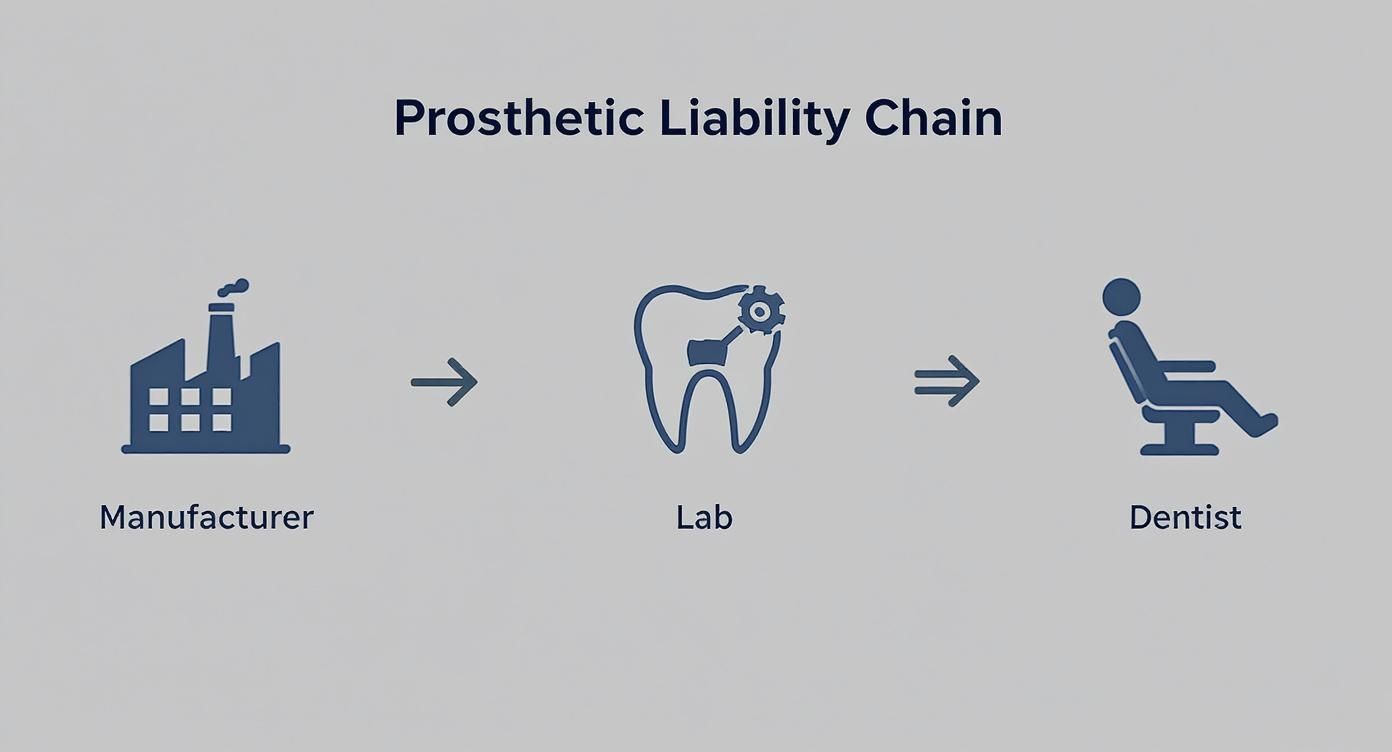
As shown, diagnosing a defect requires seamless dialogue between you, your laboratory technician, and potentially the component manufacturer.
Step 1: Initial Patient Consultation and Assessment
The first step is a comprehensive clinical examination to determine the root cause: is the issue clinical, material-related, or due to patient factors? The nature of the problem—be it a chipped veneer, a debonded crown, or a fractured prosthetic screw—will guide the diagnostic process.
A robust assessment includes:
- A Detailed Patient Interview: Elicit the patient's account of the event. When was the issue noticed? What were the circumstances? Is there associated pain or functional impairment? This narrative provides crucial context.
- A Thorough Clinical Examination: Evaluate the prosthetic's stability, marginal integrity, and occlusion. Inspect for signs of wear, micro-fractures, or other damage.
- Essential Radiographic Imaging: Utilize periapical radiographs or CBCT scans to assess the implant-abutment interface, supporting bone, and integrity of subgingival components.
This initial workup is critical for determining the next steps and identifying whether the responsibility lies with the clinic, the laboratory, or the manufacturer.
Step 2: Meticulous Documentation
If the clinical examination is the foundation, documentation is the framework that supports your position. In the event of a dispute, comprehensive records provide objective, indisputable evidence.
Meticulous record-keeping is not a procedural formality; it is your strongest defense in any warranty dispute. It transforms a subjective complaint into actionable data.
Your documentation should include:
- High-Quality Clinical Photographs: Capture images from multiple angles. Obtain detailed intraoral shots and, if the prosthetic is removed, extraoral photographs. A macro lens is invaluable.
- Detailed Clinical Notes: Record all examination findings, the patient's history of the event, and your initial diagnosis. Maintain objective, factual language.
- Original Treatment Records: Compile the initial treatment plan, signed consent forms, original impressions or digital scans, and the laboratory prescription.
With this evidence assembled, you can engage effectively with your dental laboratory.
Step 3: Coordination with Partners
Engage your partners with clear, professional communication. Provide the dental laboratory with all gathered documentation—photographs, clinical notes, and a concise summary of the problem.
If a component failure is suspected—for instance, a fractured abutment from a reputable supplier like Alfa Gate—involve the manufacturer or their local distributor. They will have specific protocols for warranty claims, which typically include returning the failed part for analysis. Adhering to their process ensures the fastest resolution for your patient. For more insights on achieving predictable outcomes, explore the benefits of guided surgery in Germany.
By following a systematic protocol, you can manage a challenging situation with professionalism and reinforce your commitment to patient care.
Best Practices for Risk Mitigation
The most effective approach to managing the complexities of Gewährleistung bei Zahnersatz is proactive. Implementing preventative measures clarifies responsibilities, manages patient expectations, and protects all stakeholders.
A transparent, well-documented process minimizes disputes and builds lasting trust, beginning long before a prosthetic is placed.
Fortifying Patient Agreements
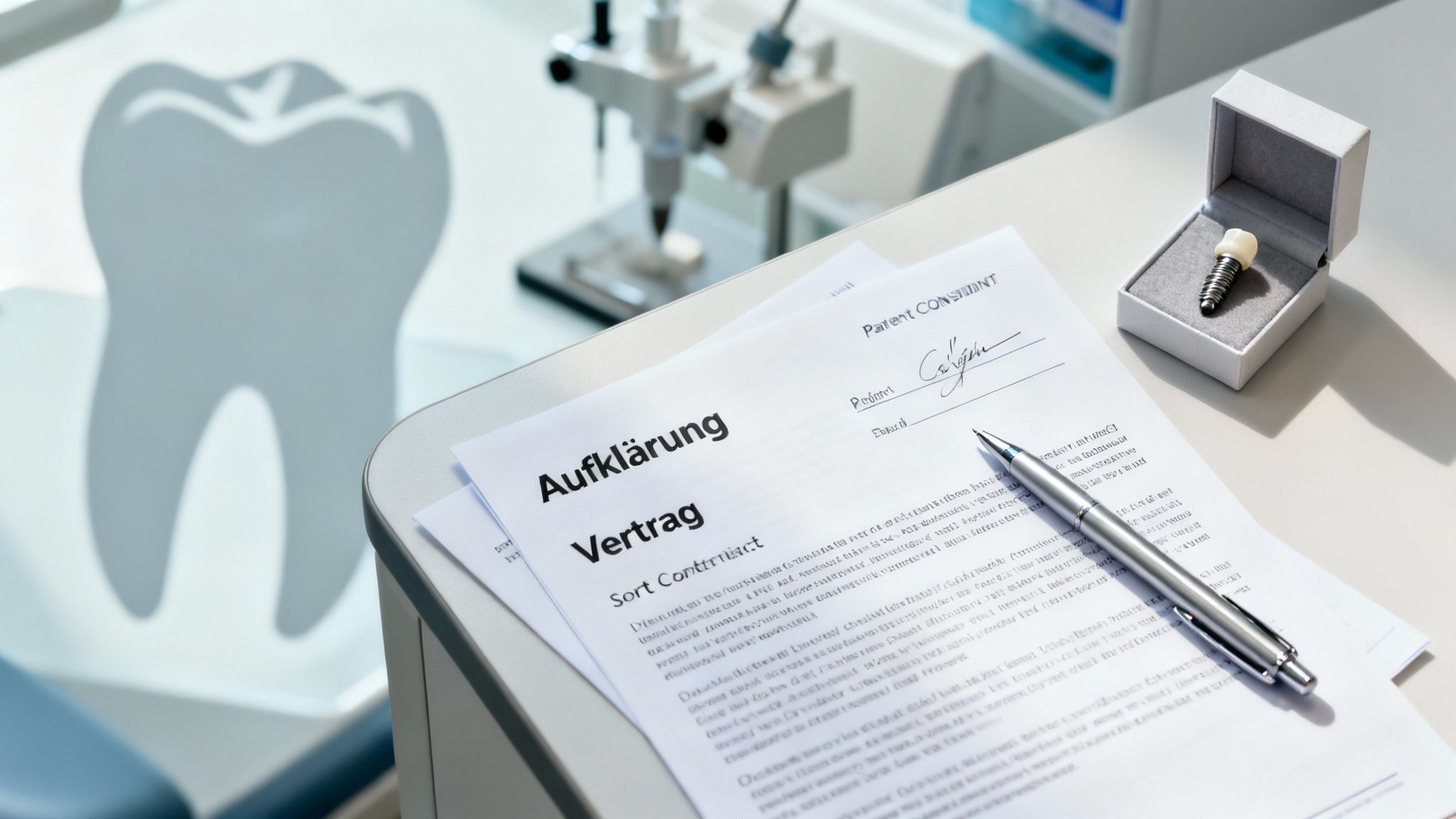
The patient consent form ('Aufklärung') and treatment plan are primary risk management tools. These documents must be more than formalities; they are binding agreements that should clearly delineate the scope and limitations of the statutory warranty.
Effective patient-facing documents must detail:
- Warranty Scope: Explain that the two-year Gewährleistung covers material and workmanship defects present at the time of delivery.
- Exclusions: Specify conditions not covered, such as accidental damage, poor oral hygiene, or issues arising from changes in the patient's systemic health.
- Patient Responsibilities: Outline the patient's role in prosthetic care, including adherence to recall schedules and proper home care protocols.
Written clarification of these expectations creates a shared understanding and mitigates future misunderstandings.
Structuring Laboratory Contracts
The relationship with your dental laboratory is equally critical. A robust contract should define liability and material specifications with precision to prevent disputes over responsibility.
Your laboratory agreements should specify:
- Material Certification: Mandate the use of certified, high-quality materials and require documentation tracing their origin.
- Liability Clauses: Clearly articulate the laboratory's responsibility for fabrication defects and outline the protocol for remakes under warranty.
- Communication Protocols: Establish a documented process for case submission, design approval, and quality control checks.
This clarity ensures a straightforward and efficient resolution if a fabrication-related issue arises. A strong partnership is essential, and you can learn more about selecting the beste zahnimplantate deutschland and the partners who supply them in our related content.
Empowering Distributors with Clear Information
For distributors, risk management involves equipping clinical partners with comprehensive, transparent information. When supplying advanced products like Alfa Gate's implant systems, providing clear warranty details is essential. This empowers dentists to communicate accurately with patients and laboratories.
Clear product information from distributors is a vital link in the chain of responsibility, helping clinicians make informed decisions that reduce long-term risk.
Distributors should provide clinics with accessible documentation covering manufacturer guarantees, material specifications, and recommended clinical protocols. This proactive education helps prevent component misuse and ensures clinicians can confidently stand behind the restorations they deliver. Partners committed to this level of support should explore what it means to become an Alfa Gate partner.
Ultimately, mitigating risk in prosthetic dentistry relies on meticulous planning and transparent communication. This proactive effort protects your practice, strengthens professional partnerships, and reinforces patient confidence.
A Confident Approach to Prosthetic Warranties
Mastering Gewährleistung bei Zahnersatz is fundamental to running a trustworthy and successful dental practice or distribution business in Germany. It signifies a commitment to clinical excellence and accountability.
The process begins with a clear understanding of the crucial distinction between the legally required two-year Gewährleistung (statutory warranty) and a voluntary Garantie (guarantee). Differentiating these concepts is the first step toward managing patient and partner expectations professionally.
The Pillars of Practice Success
Confident management of prosthetic warranties rests on three core pillars. Excelling in these areas not only protects your practice but also strengthens partnerships and enhances patient satisfaction.
- Clear Communication: Maintain transparency from the initial consultation. Ensure patients understand the warranty's scope, their maintenance responsibilities, and the protocol for addressing any issues.
- Meticulous Documentation: Clinical notes, photographs, and records are your most valuable assets. They provide an objective timeline and are indispensable when coordinating with a laboratory or manufacturer to resolve a claim.
- Strong Partnerships: The quality of your outcomes is directly linked to your partners. Collaborating with a high-quality dental laboratory and using reliable components from a trusted manufacturer like Alfa Gate significantly reduces the risk of prosthetic failure.
Adhering to these principles does more than ensure legal compliance; it builds clinical credibility. It demonstrates that you stand behind your work and can manage challenges professionally, turning potential problems into opportunities to fortify patient trust.
The financial aspect is also significant. In Germany, statutory health insurance often covers only a portion of prosthetic costs, leaving patients with substantial out-of-pocket expenses. This makes clear warranty discussions even more critical. You can find more information on the cost of dental prosthetics in Germany in our detailed article.
The fact that supplementary dental insurance policies reached 18.4 million in 2022 highlights patients' desire for financial security in their dental investments. You can learn more about dental insurance coverage in Germany on how-to-germany.com.
Integrating these best practices into your daily workflow builds a foundation for long-term success and a reputation for excellence.
Ready to build your practice on reliability and trust? Explore Alfa Gate’s advanced implant and prosthetic solutions, engineered for predictable, lasting results. Contact us today to learn more or discuss partnership opportunities.
Your Questions, Answered
Navigating the daily practicalities of Gewährleistung bei Zahnersatz can raise specific questions. Here are clear answers to common inquiries from dental professionals.
What's The Difference Between My Warranty And The Lab's?
These are two distinct but interconnected obligations. Your statutory warranty (Gewährleistung) to the patient covers the entire clinical outcome. This includes diagnosis, treatment planning, tooth preparation, and the final placement of the restoration. You are responsible for the clinical success of the treatment.
The dental laboratory's warranty is provided to you, not the patient. It covers the physical prosthetic—its materials and fabrication quality.
For example, if a crown fails due to an occlusal premature contact, this is a clinical issue falling under your Gewährleistung. If the same crown fractures due to porosity in the ceramic, it is a fabrication defect, and the laboratory is responsible for the remake.
Can I Offer A Warranty Longer Than The Standard Two Years?
Yes. You can offer a voluntary guarantee (Garantie) that extends beyond the legally mandated two-year Gewährleistung. Many practices offer a five-year guarantee on certain restorations as a means of building patient trust and differentiating their services.
However, the terms of this guarantee must be clearly documented. This document should specify what is covered (e.g., material failure under normal function) and what is excluded (e.g., accidental damage, poor oral hygiene, or failures related to new pathology).
How Do High-Quality Components Affect My Warranty Obligations?
Using certified, high-quality components from a trusted manufacturer like Alfa Gate is a key risk-management strategy. It significantly reduces the probability of material failure, a common cause of warranty claims. While it does not alter your clinical responsibilities under Gewährleistung, it provides a more reliable foundation for your restorative work.
Choosing premium components is an investment in predictability. It helps eliminate material defects as a variable, allowing you to focus on clinical execution with greater confidence.
Furthermore, reputable manufacturers provide their own warranties or guarantees on their products. In the rare event of a component defect, this simplifies the resolution process. The manufacturer will typically supply a replacement part, streamlining coordination with the laboratory and ensuring a swift resolution for the patient. Explore how precision engineering supports clinical success with Alfa Gate prosthetic solutions.
Who Pays For The Rework If Something Goes Wrong?
Under German law, the principle of Nacherfüllung (supplementary performance) requires the party responsible for the defect to cover the cost of remediation.
If the laboratory is at fault for a fabrication error, they are obligated to remake the prosthetic at no charge to your practice. If the issue stems from a clinical error, such as a distorted impression or improper preparation, your practice is responsible for the clinical time and materials required for the correction. This underscores the importance of clear communication, meticulous records, and strong laboratory partnerships.
At Alfa Gate, we believe that predictable, lasting results are born from quality components and strong professional partnerships. Our implant systems are engineered to give you the performance you need to minimise complications and stand behind your work with total confidence. For more on implant dentistry, check out our article on guided surgery in Germany. If you are a distributor who shares our commitment to excellence, we invite you to become a partner and help us bring superior solutions to clinicians around the world.