



A Clinician's Guide to the Digital Medical Academy
What exactly is a digital medical academy? It is far more than a library of online videos. A more accurate description is a comprehensive, interactive training platform designed to help dental professionals master advanced digital workflows—from CBCT diagnostics to the in-house fabrication of prosthetics using CAD/CAM technology.
This represents a fundamental shift in professional development, moving beyond traditional seminars to a more integrated approach for building clinical skills.
The Evolution of Dental Professional Development
Dentistry is undergoing a rapid transformation. The transition from analogue to digital techniques, particularly in implantology, presents both a significant opportunity and a steep learning curve. A digital medical academy is purpose-built to bridge this gap, offering a structured yet flexible pathway to proficiency with the latest tools and clinical protocols.
For a modern practice, this is not merely about staying current—it is about gaining the confidence and skill to deliver superior patient outcomes in an increasingly competitive field. This educational model transcends theory, creating a deep, practical understanding of complex procedures. By blending didactic knowledge with hands-on digital simulations, these platforms allow clinicians to build real confidence before patient treatment.
Key Advantages of a Digital Academy
Unlike a standalone weekend course, a digital learning platform provides a curriculum that builds skills incrementally. Clinicians master foundational principles before advancing to more complex applications. For both individual practitioners and the practice as a whole, the benefits are clear:
- Structured Learning Pathways: The curriculum is logically organised, guiding participants from fundamental skills like intraoral scanning to complex procedures such as full-arch reconstructions with guided surgery.
- Enhanced Clinical Precision: Mastery of digital workflows directly improves the accuracy of diagnostics, treatment planning, and implant placement—the cornerstones of modern implant dentistry. This precision is crucial for achieving predictable osseointegration and long-term stability.
- Improved Practice Efficiency: Developing in-house digital capabilities—from designing surgical guides to milling restorations—reduces dependence on external labs. This translates to shorter treatment times and increased patient satisfaction.
- Flexible and Accessible Education: Learning can occur at a self-determined pace, fitting into any schedule without requiring the cancellation of patient appointments or travel. This makes continuous professional development practical for busy clinicians.
A digital medical academy can be viewed as a clinical flight simulator for advanced dentistry. It provides a controlled, educational environment to master complex digital workflows, ensuring procedures are predictable and successful in real-world applications.
Ultimately, a digital medical academy empowers dentists not just to adopt new technology, but to truly master it. This mastery leads to superior patient outcomes, whether achieving optimal osseointegration with a precisely placed implant or delivering a functionally and aesthetically superior final restoration.
For practices looking to pair advanced training with clinically proven tools, exploring options like the Alfa Gate Bioactive implant system is a logical next step.
Mastering the Core Digital Dentistry Curriculum
A robust digital medical academy is not an arbitrary collection of webinars. It is a structured journey designed to build real-world, chairside skills from the ground up. The objective is to develop proficiency step-by-step, ensuring each new technique is built upon a solid foundation.
The curriculum begins with the fundamentals of digital data acquisition. This initial module focuses on mastering intraoral scanners and Cone Beam Computed Tomography (CBCT). Competence in this area is non-negotiable, as the precision of the entire digital workflow—every plan, guide, and restoration—depends on the quality of the initial scan data.
From Digital Diagnostics to Guided Surgery
Once comfortable with acquiring clean data, the learning path progresses to digital treatment planning. Here, clinicians learn to merge CBCT and STL files to create a highly detailed 3D model of the patient’s anatomy. This is where the power of digital dentistry becomes evident, allowing for meticulous pre-surgical planning that considers bone density, nerve locations, and ideal implant positioning.
This planning phase flows directly into the principles of computer-guided surgery. The curriculum details the process of converting the digital blueprint into a physical, patient-specific surgical guide. The clinical result is significant: procedures become more predictable and less invasive, often leading to faster patient recovery. A deep understanding of CBCT is critical, and you can explore the technical expertise of digital volume tomography to fully grasp its central role.
Mastering In-House Prosthetic Design
The final component of the core curriculum is CAD/CAM prosthetics. This module gives the clinician full control over the restorative phase. Participants gain hands-on experience with the principles of digitally designing crowns, bridges, and custom abutments, understanding the complete workflow for in-house milling or 3D printing.
This skill alone can transform a clinic's operational dynamics. It reduces dependence on external labs, shortens turnaround times, and provides complete authority over the final aesthetic outcome, creating one seamless, efficient process from the initial scan to the final restoration.
The infographic below illustrates how a well-structured academy delivers these interconnected benefits, enhancing clinical skills, patient outcomes, and overall practice efficiency.
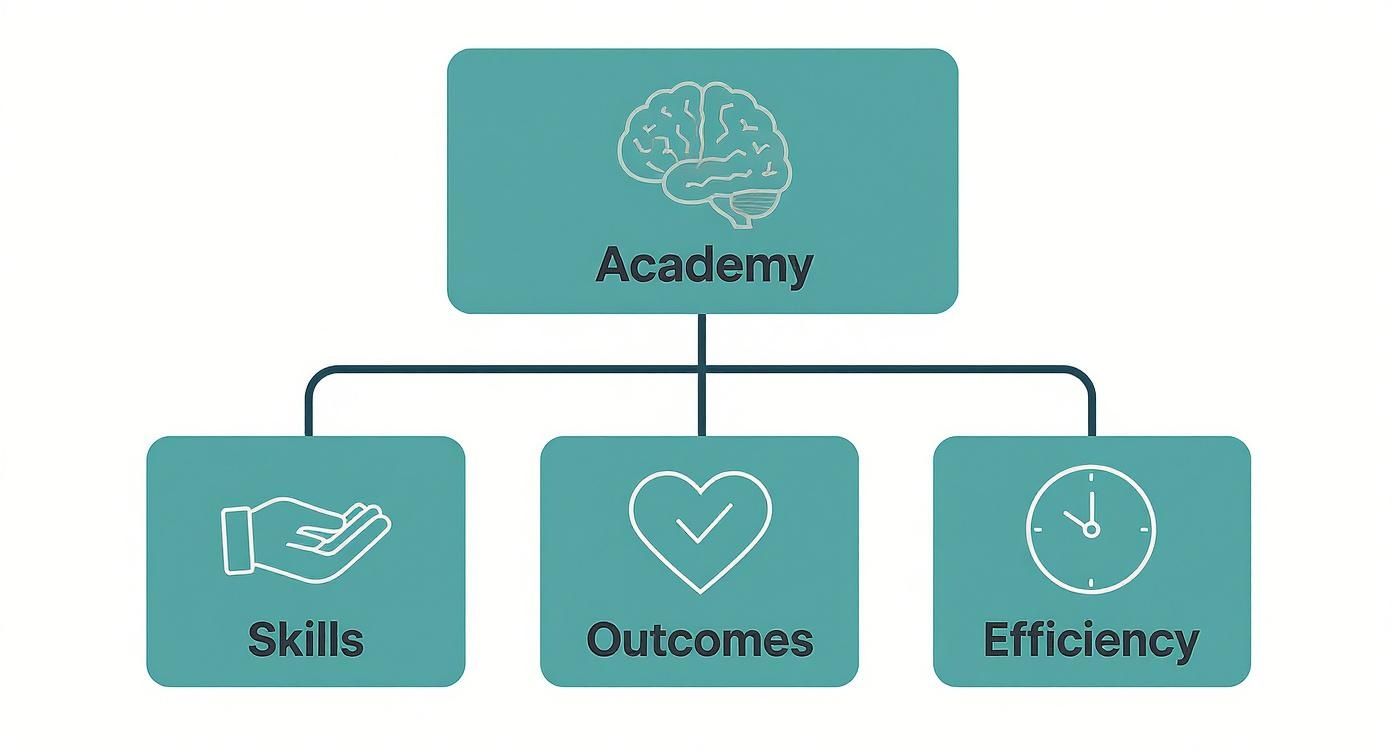
This demonstrates how mastering the core curriculum translates directly into tangible improvements across the entire practice.
The true advantage of a digital academy lies in its integrated approach. It does not simply teach how to use a scanner; it teaches how that scan informs a surgical guide, which in turn ensures a perfectly positioned implant ready for a precisely designed restoration.
The on-demand, structured format of a digital academy offers a distinct advantage over attending disparate weekend seminars, fitting into a clinician's demanding schedule while delivering a more effective and lasting education.
Digital Academy Learning Pathways vs. Traditional Seminars
This table compares the learning of core digital dentistry skills within a modern academy versus a traditional, standalone seminar setting.
| Curriculum Module | Key Skills Learned | Clinical Application and Benefit |
|---|---|---|
| Digital Data Acquisition | Mastering intraoral scanning and CBCT protocols for clean, accurate data. | Produces reliable diagnostic models, leading to fewer errors and remakes downstream. |
| Implant Treatment Planning | Merging STL and DICOM files, virtual implant placement, nerve mapping. | Enables meticulous pre-surgical planning for optimal outcomes and patient safety. |
| Computer-Guided Surgery | Designing surgical guides, understanding drilling protocols, and executing the plan. | Increases procedural predictability and precision, often making surgery less invasive. |
| CAD/CAM Prosthetics | Designing crowns, bridges, and abutments; managing in-house milling/printing. | Drastically reduces lab turnaround times and gives full control over the final restoration. |
The difference is clear. An integrated digital pathway is designed for deep learning and confident clinical application, not just temporary exposure to a new concept. Mastering this core curriculum provides an end-to-end digital skillset that elevates clinical confidence and the quality of patient care.
Unlock Your Practice's Clinical and Business Potential
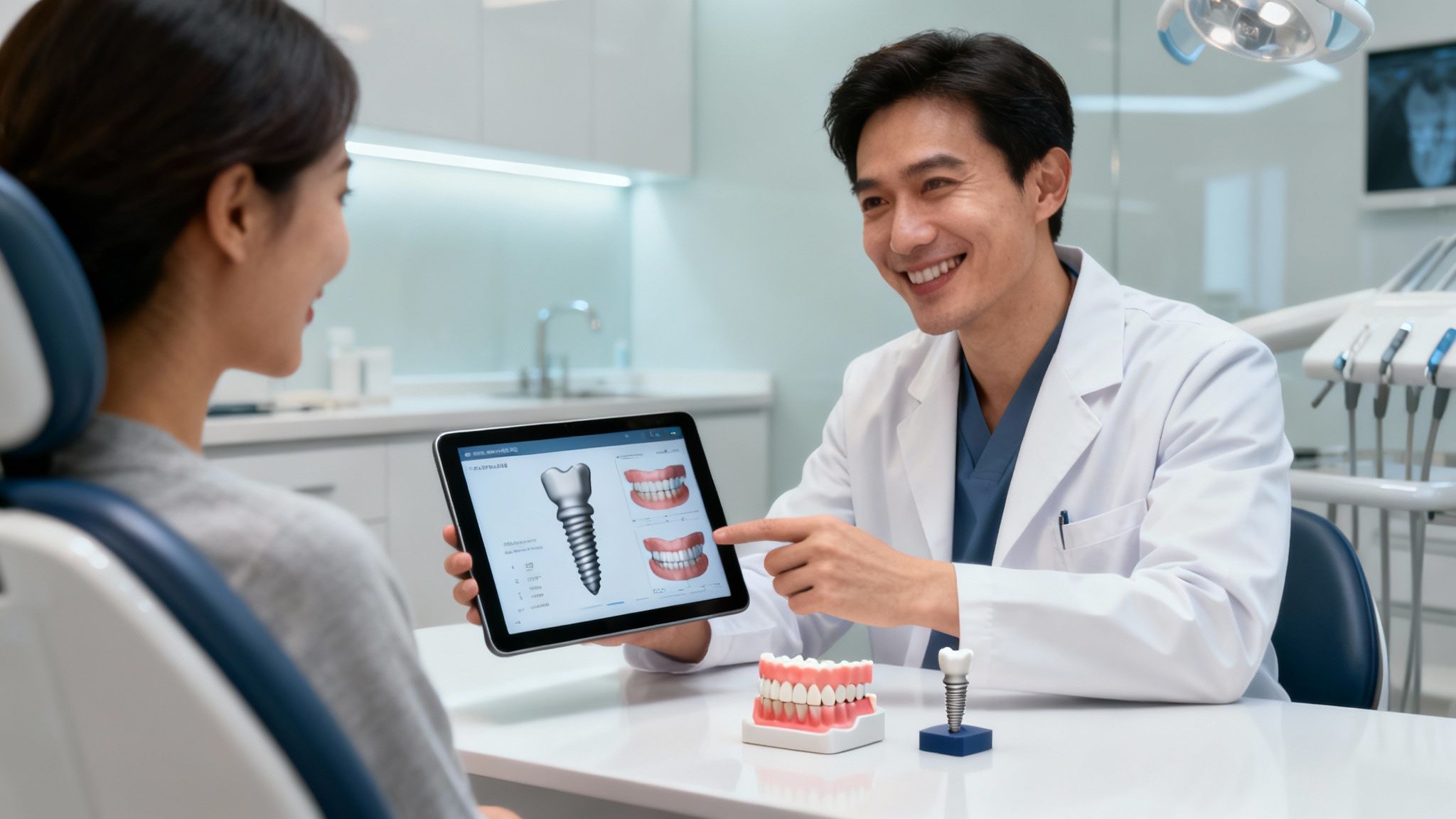
The true value of a digital medical academy is realized through its direct impact on daily practice. Mastering digital workflows is not just about theoretical knowledge; it is a strategic shift that yields measurable benefits in clinical results and financial performance.
This creates a positive feedback loop: superior clinical work strengthens the business, which in turn allows for further investment in advanced clinical tools and training.
Clinically, the most immediate improvement is a dramatic increase in precision. Skills central to academy training, such as digital treatment planning and guided surgery, remove guesswork from implant placement. This leads to more predictable outcomes, reliable osseointegration, and long-term implant stability—all contributing to superior patient care.
Achieving Superior Clinical Outcomes
Efficiency gains are equally significant. A streamlined digital workflow can dramatically reduce chair time for complex implant procedures. A clinician proficient in guided surgery can place an implant using a less invasive technique, resulting in reduced chair time and a faster, more comfortable recovery for the patient.
This level of precision also minimizes unforeseen complications and the need for revisions. When an implant is placed in the ideal position with the correct angulation from the outset, the entire prosthetic phase is simplified, and the final aesthetic result is superior.
Here is a breakdown of the clinical advantages:
- Unmatched Accuracy: Digital planning allows for the mapping of bone density, nerve pathways, and sinus locations with sub-millimeter accuracy before any surgical intervention.
- Predictable Results: Guided protocols ensure that surgical execution precisely matches the digital plan, leading to consistently excellent outcomes.
- Minimally Invasive Procedures: Surgical guides often permit flapless surgery, reducing patient discomfort and accelerating healing.
- Optimized Restorations: Ideal implant placement simplifies the restorative process, guaranteeing better function and aesthetics for the final prosthesis.
Driving Business Growth and Efficiency
The skills acquired through a digital academy also serve as a powerful engine for business growth. The ability to use 3D visualizations during patient consultations is a prime example. Showing a patient their own anatomy in 3D with a virtual implant in its planned position is a highly effective communication tool.
This clarity builds immediate trust and can significantly improve case acceptance rates.
Bringing processes like surgical guide fabrication and prosthetic design in-house also creates remarkable efficiency. It reduces reliance on external laboratories, shortening treatment timelines and lowering the cost per case. To understand this better, explore the role of 3D printing in modern dental technology, a key component of this approach.
Investing in digital education is a direct investment in a practice’s two most valuable assets: its clinical reputation and its financial health.
Ultimately, mastering digital dentistry enables a practice to offer more advanced services. Clinicians can confidently manage complex, high-value cases that might have been previously referred out, boosting revenue and cementing the practice's reputation as a center for advanced dental care.
The Essential Technology for Your Digital Journey
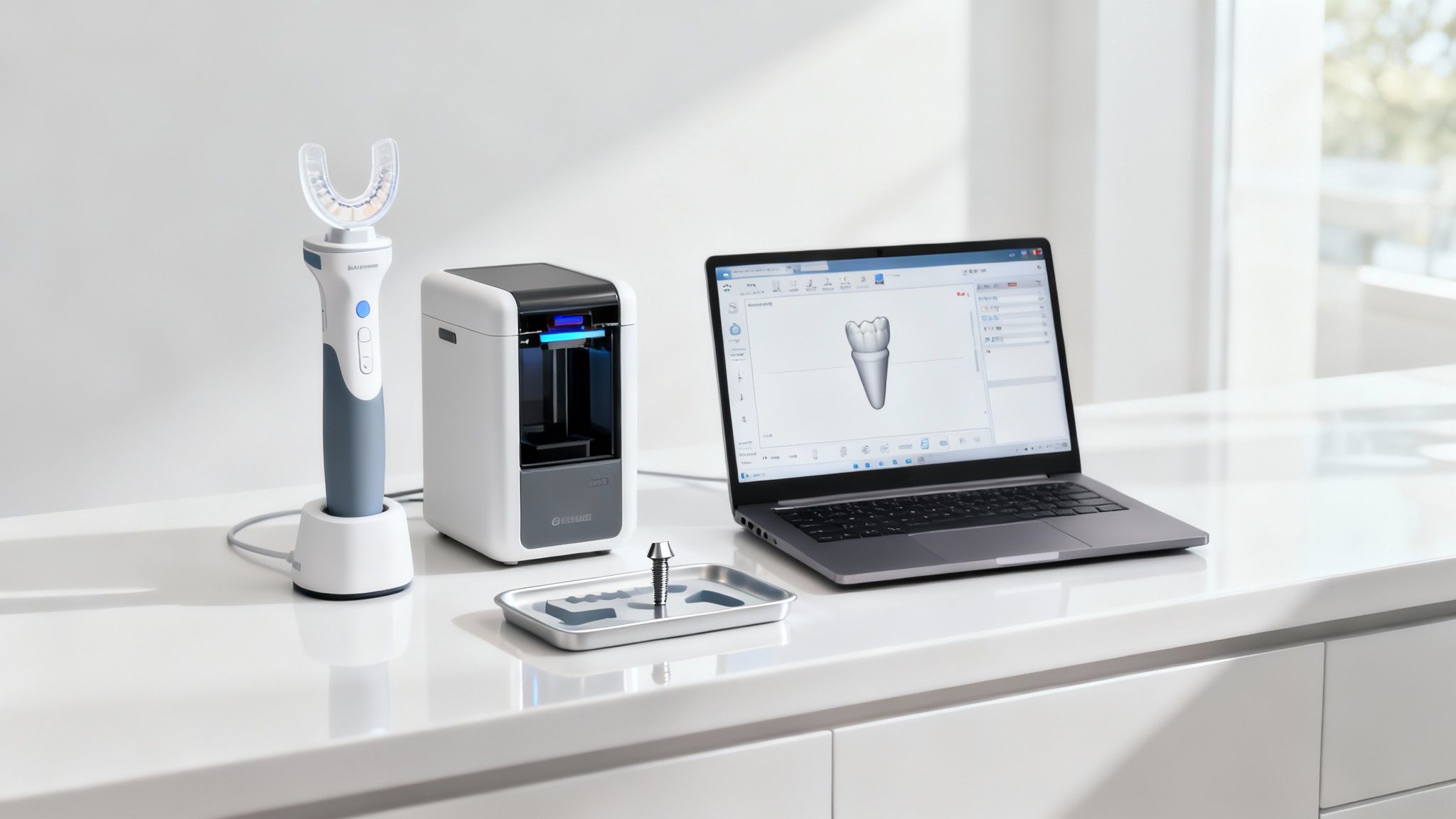
To maximize the benefits of a digital medical academy, the right clinical tools are essential. This is not about acquiring the most expensive equipment, but about selecting technology that integrates seamlessly with the training and daily clinical practice. The goal is to create a direct feedback loop where learned concepts immediately enhance chairside work.
Digital education is most effective when the principles taught can be applied using the same type of data generated within one's own practice.
Core Hardware for Digital Dentistry
At the foundation of any digital workflow is clean, accurate data, which is generated by hardware. While a wide range of options exists, several key pieces of equipment are central to modern implantology and essential for applying learned skills.
These tools are the instruments that translate new knowledge into predictable, high-quality patient outcomes.
- Intraoral Scanners: This is the entry point to digital dentistry. A quality intraoral scanner replaces traditional impressions, capturing precise 3D models of the patient's dentition and soft tissues. Working with one's own STL files during training modules reinforces the learning process.
- CBCT Machines: For implantology, Cone Beam Computed Tomography is non-negotiable. It provides critical anatomical data—bone volume, nerve pathways, sinus positions—necessary for planning safe and accurate implant placements.
- 3D Printers and Milling Machines: These devices bring digital plans into the physical realm. An in-house 3D printer is ideal for fabricating surgical guides, dental models, and temporary restorations. A milling machine allows for the fabrication of permanent crowns, abutments, and bridges in-clinic, providing complete control over the final product.
Choosing the Right E-Learning Platform
As critical as the hardware is the software—specifically, the educational platform. A well-designed digital medical academy is more than a video player; it is an interactive learning environment built to foster a deep, practical understanding of new skills.
When evaluating platforms, focus on features that promote active learning. A high-quality learning management system (LMS) should offer a rich, engaging experience that facilitates information absorption.
The best digital learning platforms blur the line between education and clinical simulation. They should enable hands-on practice with real-world case data in a virtual environment, building confidence and competence before patient treatment.
Key platform features to look for include:
- Interactive 3D Anatomical Models for visualizing complex surgical sites.
- High-Definition Surgical Videos with clear expert commentary.
- Integrated Treatment Planning Software for hands-on practice with virtual implant placement.
- Peer-to-Peer Discussion Forums for collaboration and knowledge sharing.
Selecting the right combination of hardware and software is a crucial first step. To see how these components integrate in a restorative workflow, our guide on CAD/CAM technology in dentistry provides excellent context. By aligning technology with education, you create a powerful synergy that accelerates the journey to mastery in digital implantology.
Weaving Digital Training into Your Practice’s Workflow
Completing a course at a digital medical academy is an achievement; integrating those skills into the clinic's daily routine is the ultimate goal. The true success lies not just in theoretical knowledge but in transforming that knowledge into a consistent, predictable clinical process.
This requires a deliberate plan to bridge education and execution, involving team buy-in and fostering a culture of continuous learning.
Building a Culture That Embraces Learning
A primary obstacle to adopting new digital workflows can be resistance to change. Overcoming this requires involving the entire team from the outset. This initiative should be framed as a shared mission to improve patient care, enhance efficiency, and foster professional growth.
Start with small, manageable steps. Dedicate a few hours each week for the team to complete specific training modules, followed by a brief meeting to discuss progress and challenges. This creates a supportive environment where everyone can learn and adapt together. Furthermore, prioritizing accredited courses provides a recognized certification that builds patient trust and signifies a commitment to excellence.
A Step-by-Step Plan for Implementation
A structured rollout ensures a smooth transition from the learning environment to clinical application. Here is a practical framework:
- Phase Your Goals: Begin with a foundational skill, such as mastering the intraoral scanner. Once the team is proficient, progress to digital treatment planning and then guided surgery.
- Schedule Practice Time: Allocate dedicated time for "dry runs" using anonymized patient data. This provides a pressure-free setting for the team to practice the entire workflow before treating patients.
- Identify Digital Champions: Empower team members who are enthusiastic about the new technology to serve as internal resources, assisting colleagues as needed.
- Review and Adapt: Regularly assess the new digital workflows. Solicit feedback from the team to identify bottlenecks and areas requiring additional training, and refine processes accordingly.
The impact of structured learning is well-documented. The Digital Medical Academy (DMA) in Germany found that its partnerships with over 100 healthcare institutions resulted in a 30% increase in the adoption of digital health practices, demonstrating a direct correlation between formal training and real-world implementation. You can explore the full impact of structured digital education on DMA's platform.
True integration is achieved when "digital" is no longer a separate task but is simply the way the practice operates to deliver exceptional care.
This is the philosophy behind the Alfa Gate digital ecosystem. Our solutions, from the Alfa Guide Surgical System to our full range of prosthetic components, are designed to integrate seamlessly with the skills acquired at a digital medical academy. For those looking to join a network that supports this forward-thinking approach, we invite you to become a distributor.
Your Questions About Digital Dental Academies, Answered
Embarking on a new educational path inevitably raises questions. For dentists and practice owners considering a digital medical academy, common concerns revolve around time commitment, team integration, and return on investment. Let's address these directly.
How Much Time Does a Digital Implantology Course Really Take?
A key advantage of a digital academy is its flexibility. The time required depends on the complexity of the subject matter.
Foundational skills, such as intraoral scanning or basic digital design, may require 10-15 hours of self-paced learning. An advanced certification in a topic like full-arch guided surgery could involve a more intensive 40-60 hours spread over several weeks. The significant benefit is that this high-level training can be completed without disrupting patient schedules or incurring travel expenses.
Is This Kind of Training Good for My Whole Team?
Yes, it is essential. The most successful digital practices are those where the entire team—from administrative staff to technicians—is aligned.
A comprehensive digital academy offers tailored learning tracks for each role. While clinicians focus on surgical and restorative techniques, other team members can advance their skills concurrently.
- Dental Assistants: Can master digital impression acquisition, equipment maintenance, and data management.
- Dental Technicians: Can refine their expertise in CAD/CAM design, new materials, and in-house fabrication workflows.
- Administrative Staff: Can learn to use digital visuals to explain treatment plans, which can significantly improve case acceptance.
Training the entire team fosters a collaborative and highly productive clinical environment.
A webinar is like a single chapter, offering a snapshot of a topic. An academy course is like the entire book, designed for deep understanding and the confidence to apply knowledge clinically.
What's the Real Difference Between a Webinar and an Academy Course?
This question highlights a crucial distinction in educational formats. A webinar is typically a one- to two-hour presentation on a specific topic, excellent for a high-level overview or an introduction to a new product.
An academy course, by contrast, is a structured, comprehensive curriculum. It includes multiple modules, practical assignments, access to expert instructors, and often results in a certification. The objective is not just to disseminate information but to build genuine, durable skills.
How Can I Actually Measure the ROI on This?
The return on investment from digital training is tangible and can be measured through clear clinical and financial metrics.
To assess the ROI, track the following key performance indicators:
- Clinical Improvements: Monitor reductions in procedure times, especially for complex implant cases. Track decreases in material waste and the frequency of remakes.
- Financial Gains: Calculate new revenue from high-value cases now managed in-house. Observe improvements in case acceptance rates and significant reductions in external laboratory fees.
Most practices discover that the investment in high-quality digital education provides a rapid return, strengthening both their clinical reputation and their financial performance.
Are you ready to elevate your practice with advanced clinical skills and premier implant technology? The team at Alfa Gate is here to support your journey. Explore our full range of dental implant and prosthetic solutions to see how our systems align with modern digital workflows. For personalized guidance, contact our experts today.