



A Guide to 3D Printing in Dental Technology (Zahntechnik 3D Druck)
Zahntechnik 3D Druck—3D printing in dental technology—represents a fundamental shift from manual fabrication methods to a fully digital, high-precision workflow. This guide offers dentists, dental students, and distributors actionable insights into how modern dental labs and clinics are leveraging this technology to produce everything from surgical guides to crowns with unprecedented speed and accuracy.
The Digital Future of Dental Fabrication
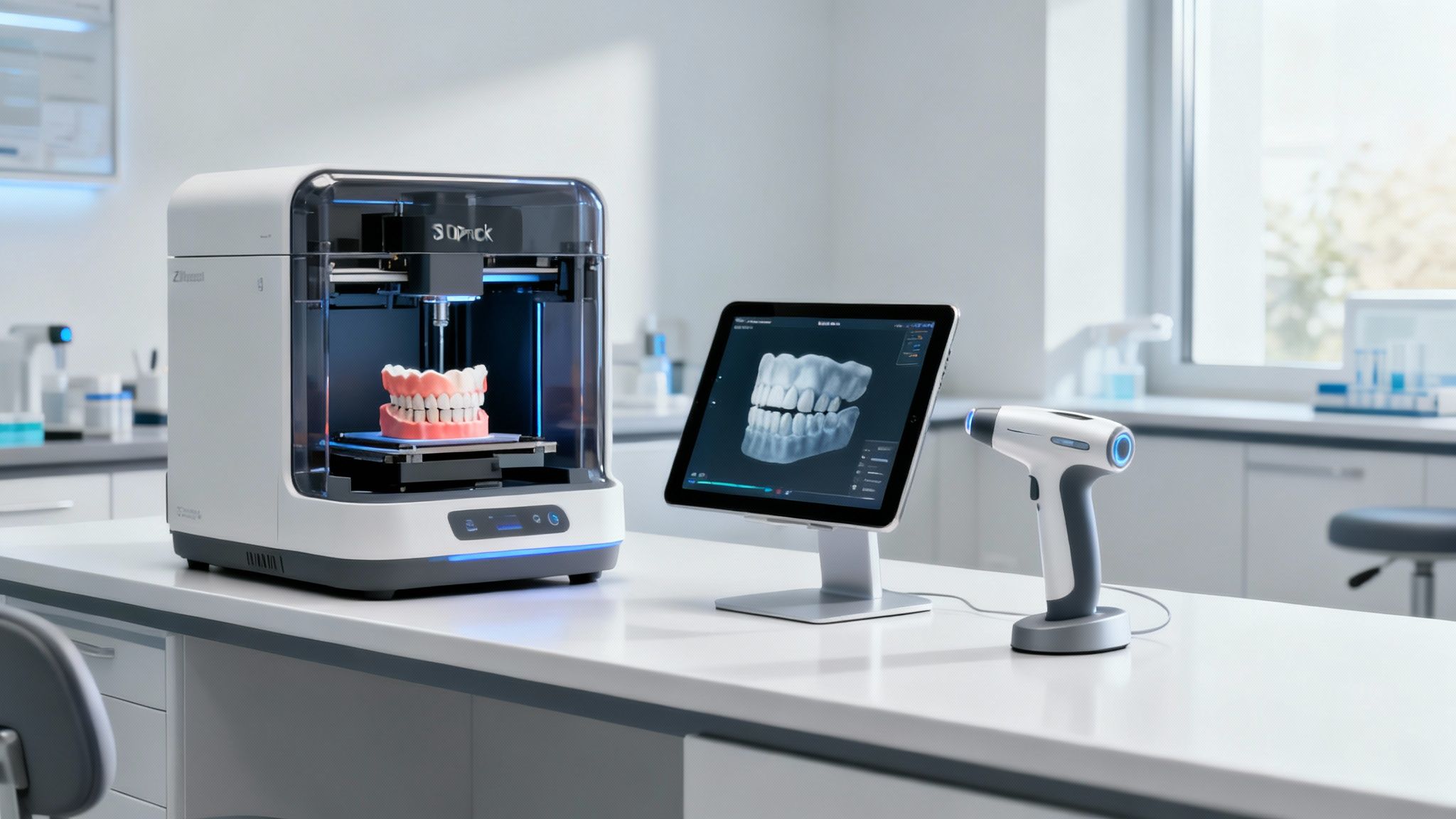
Additive manufacturing is no longer a futuristic concept but the engine powering contemporary digital dentistry. For dental laboratories, it provides a solution to the inherent limitations of manual casting and milling. This technological evolution is driven by the clinical demand for highly accurate, repeatable outcomes, particularly in implantology and prosthodontics.
Market analysis confirms this trend. The German dental 3D printing market, valued at approximately USD 306.62 million in 2025, is projected to grow at a compound annual growth rate (CAGR) of 25.6%. This growth is fueled by significant R&D investment, supportive regulations, and increasing demand for customized dental solutions. More detailed figures can be found in dental 3D printer market trends on cognitivemarketresearch.com.
From Scan to Restoration: The Digital Workflow
At the core of this revolution is a seamless digital workflow that enhances every stage of patient care. It replaces conventional physical impressions and stone models with precise digital data, minimizing errors and improving efficiency. The process is built on three foundational pillars:
- Scanning: Data acquisition begins with intraoral or desktop scanners, which capture a precise 3D image of the patient’s dentition. This forms the digital foundation for all subsequent steps.
- Designing: Using specialized CAD (Computer-Aided Design) software, technicians design restorations, surgical guides, or prosthetics with exceptional accuracy.
- Printing: The finalized digital file is sent to a 3D printer, which constructs the physical object layer-by-layer from specialized biocompatible or durable materials.
This integrated system is particularly transformative for implant dentistry. For example, a digitally designed surgical guide ensures an Alfa Gate Bioactive implant is placed in the optimal position, significantly improving the predictability of osseointegration and long-term clinical success.
By digitizing the entire process, dental professionals gain an unprecedented level of control over clinical outcomes. The result is better-fitting prosthetics, more accurate implant placements, and reduced chair time for the patient. For a deeper understanding of this digital ecosystem, explore our article on CAD/CAM dental technology advancements.
The Core 3D Printing Technologies Explained
Transitioning a digital design to a physical object relies on additive manufacturing. In zahntechnik 3d druck, three primary technologies dominate the field: Stereolithography (SLA), Digital Light Processing (DLP), and Selective Laser Sintering (SLS).
Understanding the fundamental differences between these technologies is crucial for selecting the appropriate tool for a specific clinical application. Each method builds objects layer-by-layer, but the mechanism of material solidification sets them apart, directly impacting accuracy, surface finish, material compatibility, and cost-effectiveness.
Resin-Based Printing: SLA and DLP
Both SLA and DLP technologies create objects by curing liquid photopolymer resin with a light source. The key distinction lies in how the light is delivered to the resin.
Stereolithography (SLA) utilizes a high-precision ultraviolet (UV) laser to trace the geometry of each layer onto the resin surface. This point-by-point curing method delivers exceptional detail and a very smooth surface finish, making it ideal for applications requiring high fidelity, such as detailed dental models or casting patterns. However, this meticulous process can result in longer print times.
Digital Light Processing (DLP) employs a digital projector to flash an entire layer's image at once. This approach cures a full cross-section of resin simultaneously, making DLP significantly faster than SLA. Modern DLP printers offer excellent resolution, positioning them as the preferred choice for high-throughput environments producing surgical guides, temporary crowns, or orthodontic models.
The decision between SLA and DLP often involves a trade-off between the pinpoint accuracy of SLA's laser and the high-speed production capability of DLP's projector.
Powder-Bed Printing: Selective Laser Sintering (SLS)
Selective Laser Sintering (SLS) operates on a different principle. Instead of curing liquid resin, SLS uses a powerful laser to fuse or sinter powdered material—typically polymers like nylon or, in advanced systems, metals—layer by layer.
A thin layer of powder is spread across a build platform, and the laser selectively fuses particles according to the design's cross-section. This technique is advantageous for producing strong, durable parts with complex internal geometries, such as partial denture frameworks or long-term temporaries.
A significant benefit of SLS is that the surrounding unfused powder provides inherent support, eliminating the need for dedicated support structures required in SLA and DLP. This simplifies post-processing and allows for greater design freedom. The trade-off is a more porous surface finish and typically higher initial equipment costs. For more on how these technologies are reshaping dental workflows, review our insights on the evolution of digital workflows in dentistry.
Comparing Key Dental 3D Printing Technologies
| Technology | Best For | Key Advantage | Primary Limitation |
|---|---|---|---|
| SLA | High-precision models, casting patterns, and detailed anatomical replicas. | Exceptional detail and the smoothest surface finish among resin printers. | Generally slower print speeds, especially for large or solid objects. |
| DLP | Surgical guides, temporary restorations, and orthodontic aligner models. | Fast printing speeds, making it ideal for high-volume production. | Resolution can be limited by the projector's pixel density. |
| SLS | Durable functional parts, partial denture frameworks, and complex geometries. | Produces strong, tough parts without the need for support structures. | Higher equipment cost and a rougher surface finish than resin printing. |
Ultimately, the choice of technology depends on the clinical objective. A comprehensive dental laboratory might utilize an SLA printer for master models, a DLP printer for batch production of surgical guides, and an SLS system for robust definitive prosthetics.
If you are considering integrating these technologies with advanced implant systems, please contact our team of experts for practical guidance.
Selecting the Right Materials for Clinical Success
While the 3D printer is the engine of a digital workflow, the materials are the fuel that determines clinical outcomes. The selection of an appropriate material directly impacts biocompatibility, durability, and aesthetics, making material science a critical component of digital dentistry.
A state-of-the-art printer's capabilities are defined by the resin or powder it uses. The clinical application dictates the required material properties; for example, a temporary crown demands different characteristics than a surgical guide or a flexible occlusal splint. Strength, aesthetics, and patient safety must be carefully balanced to meet all regulatory and clinical standards.
Common Material Categories and Their Applications
Dental 3D printing materials are engineered for specific clinical tasks, from temporary intraoral use to creating frameworks for permanent restorations.
-
Biocompatible Resins: These materials are essential for any application involving direct patient tissue contact. They undergo rigorous testing for cytotoxicity and must possess certifications like a CE mark or MDR approval. Common applications include surgical guides, occlusal splints, and custom impression trays.
-
Durable Polymers and Composites: Designed for functional use, these materials are ideal for printing temporary crowns and bridges. They offer a favorable combination of mechanical strength and aesthetics for provisional restorations. Advanced composite resins are also emerging for long-term applications.
-
Castable Waxes and Resins: These materials are formulated to burn out cleanly without residue, making them perfect for investment casting workflows. Laboratories use them to print detailed patterns for crowns, bridges, and partial denture frameworks, which are then cast using traditional lost-wax techniques.
-
Model and Die Resins: These resins are engineered for precision and stability. They produce highly accurate dental models and dies from digital scans, with a gypsum-like appearance and feel. Their durability allows for repeated handling and scanning in a laboratory setting.
The Critical Role of Biocompatibility and Regulation
For any 3D-printed device intended for intraoral use, biocompatibility is non-negotiable. Materials used for surgical guides, splints, or temporary restorations must be certified as safe for patient contact, meaning they have been tested to ensure they do not elicit adverse biological reactions.
Verifying a material's regulatory compliance is a fundamental responsibility for any dental professional. Using non-certified materials for patient applications compromises safety and exposes the practice to significant legal and ethical risks. Always confirm that materials possess the appropriate certifications for their intended clinical use. This synergy between material science, technology, and clinical protocol is what elevates patient care. For a closer look, see our guide on the role of CAD/CAM in modern dental technology.
Practical Tips for Material Selection
Selecting the right material involves matching its properties with the printer's capabilities and the clinical requirements. For a temporary crown, translucency and shade are important, whereas for a surgical guide, rigidity and dimensional accuracy are paramount. Investing in high-quality, certified materials from trusted suppliers is the only way to ensure consistent, reliable, and safe clinical outcomes.
From Scan To Prosthetic: Mastering The Digital Workflow
Implementing Zahntechnik 3D Druck successfully requires mastering a repeatable digital workflow. This process transforms patient anatomical data into a high-precision physical component, unlocking the full potential of additive manufacturing for predictable, high-quality results.
Each step in this sequence builds upon the previous one, making initial precision essential. An error at the scanning stage will propagate through the entire workflow.
Step 1: Digital Acquisition
The workflow begins with a precise digital impression, acquired using an intraoral scanner in the clinic or a desktop scanner in the laboratory. The objective is to create a highly accurate 3D data set that serves as the digital blueprint for the entire process.
The quality of this initial scan is critical. High-fidelity data ensures that all subsequent design and manufacturing steps are based on a true digital replica of the patient's anatomy. Modern scanners capture details at a micron level, providing the necessary accuracy for complex restorative cases and enabling seamless integration with other diagnostic tools, like CBCT scans. Learn more in our guide on Digital Volume Tomography for practitioners.
Step 2: CAD Design
The scan data is imported into specialized Computer-Aided Design (CAD) software. Here, the technician digitally designs the component—be it a surgical guide, crown, model, or denture framework—with a level of control unattainable through manual methods.
For implant procedures, this stage allows for virtual implant planning and the integration of digital libraries, such as an Alfa Gate Ti-Base, to ensure a passive fit for the final restoration. Simulating the clinical outcome digitally eliminates guesswork and significantly reduces the need for chairside adjustments.
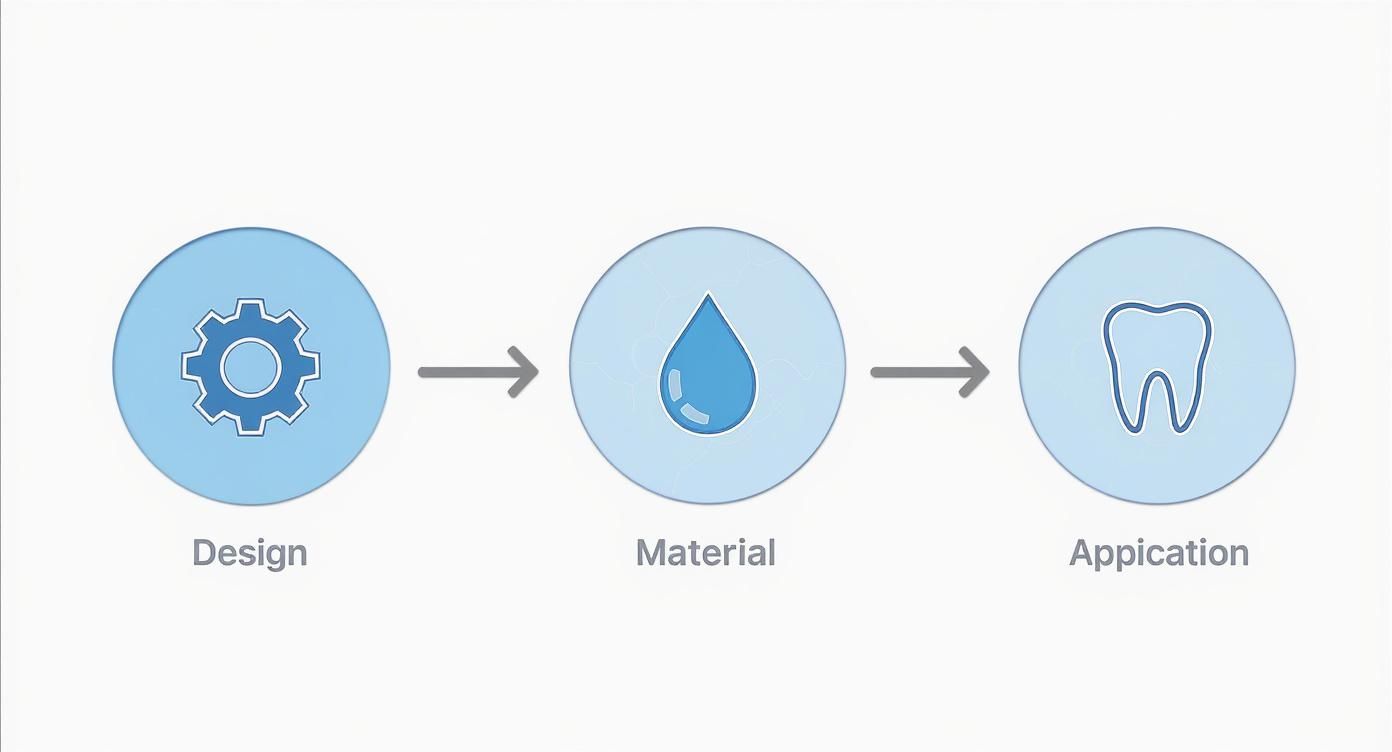
This logical progression—from design to material selection to clinical application—forms the backbone of a predictable digital process.
Step 3: Print Preparation
Before printing, the finalized design file is processed in "slicing" software. This program converts the 3D model into thousands of thin digital layers, generating a detailed instruction set for the 3D printer.
Two key decisions are made here: orientation and supports. The part's orientation on the build platform affects print time, surface quality, and accuracy. The software also generates support structures that anchor the part and prevent deformation during printing. Proper preparation is crucial for a successful print.
Step 4: Additive Manufacturing
The prepared file is sent to the 3D printer, which builds the object layer-by-layer according to the instructions. The specific technology—SLA, DLP, or SLS—determines how each layer is solidified. This is the stage where the digital file becomes a physical object.
Step 5: Post-Processing
A newly printed part requires several post-processing steps to achieve its final mechanical properties, biocompatibility, and clinical readiness.
Post-processing is a critical manufacturing stage, not an afterthought. Incomplete or improper execution can compromise the accuracy, strength, and safety of the final component.
The typical post-processing sequence includes:
- Washing: The part is cleaned in a solvent, typically isopropyl alcohol (IPA), to remove any uncured resin.
- Curing: It is then placed in a curing unit for exposure to UV light and heat, which fully polymerizes the material to achieve maximum strength and stability.
- Support Removal: The temporary support structures are carefully removed.
- Finishing and Polishing: The surfaces are smoothed and polished for aesthetics and patient comfort.
Only after this comprehensive sequence is the part ready for clinical use, ensuring it meets the high standards required for modern patient care.
Key Clinical And Laboratory Applications
The value of any dental technology is measured by its daily clinical and laboratory impact. 3D printing has transitioned from a theoretical concept to a practical tool that enhances accuracy, reduces chair time, and elevates the standard of patient care in diagnostics, treatment planning, and prosthetic fabrication.
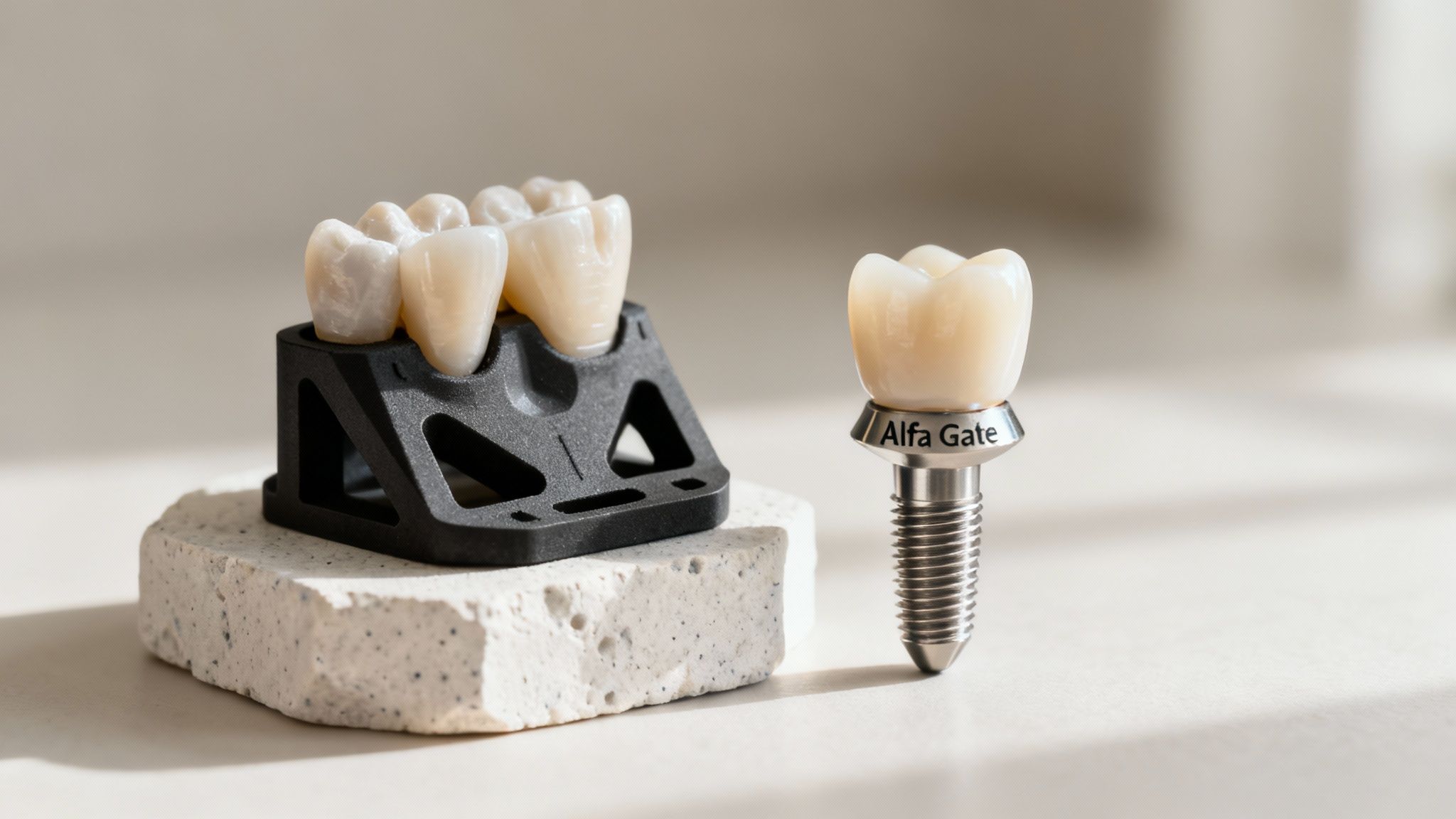
Market data reflects this rapid adoption. The dental 3D printing market in Germany is projected to grow from USD 235.5 million in 2023 to USD 1,171.6 million by 2030, a compound annual growth rate of 25.8%, with prosthodontics being a primary driver. You can explore the full dental 3D printing market findings here.
Precision Dental Models For Case Planning
One of the most powerful applications of dental 3D printing is the creation of highly accurate physical models from digital scans. These models offer superior detail and dimensional stability compared to traditional stone models.
Printed models are indispensable for:
- Diagnostic wax-ups for restorative treatment planning.
- Verifying the fit and contacts of crowns and bridges.
- Fabricating precisely fitting orthodontic appliances and retainers.
This level of precision is crucial for complex implant cases, allowing for physical verification of prosthetic designs before clinical intervention.
Custom Surgical Guides For Implant Placement
In implantology, 3D-printed surgical guides have had a profound impact. Designed using merged CBCT and intraoral scan data, these guides translate a digital treatment plan into a predictable surgical procedure.
The guide fits precisely over the patient's existing anatomy, with integrated sleeves that dictate the exact angle, depth, and position of the implant osteotomy. The clinical advantages over freehand placement are significant.
By using a custom surgical guide, clinicians can ensure the implant is placed in the optimal restorative position, avoiding critical anatomical structures and achieving ideal primary stability. This predictability is the cornerstone of long-term implant success.
This process ensures that an Alfa Gate Bioactive implant is positioned exactly as planned to support the final restoration, maximizing bone-to-implant contact and promoting optimal osseointegration.
Temporary Restorations For Immediate Function
3D printing enables the rapid, in-house production of temporary crowns, bridges, and full-arch restorations. Using durable, aesthetic resins, technicians can create provisional restorations that are both functional and natural-looking.
This capability is highly beneficial for immediate loading protocols in implant dentistry. A temporary can be fabricated before the patient’s surgical appointment, allowing them to leave the same day with a functional, aesthetic smile that also protects the surgical site. For more on modern prosthetic workflows, review our guide on how to order a dental prosthesis online.
Orthodontic Aligners And Appliances
3D printing has revolutionized orthodontics by enabling the production of series of precise models, each representing a stage of tooth movement. Clear aligners are then thermoformed over these models. This digital workflow makes mass customization of clear aligner therapy efficient and accessible. Additionally, other custom appliances like retainers and splints can be printed with a perfect fit.
If you are a distributor interested in providing these advanced solutions, we invite you to Become a distributor and partner with a leader in digital dentistry.
Making 3D Printing Work in Your Practice
Integrating Zahntechnik 3D Druck into a clinical or laboratory setting is a strategic decision that enhances efficiency and patient care. The key is to align the technology with specific operational needs, considering not only the initial purchase price but also software, materials, and ongoing operational costs.
The optimal printer is one that addresses your primary production demands. A practice focused on implantology may benefit from a high-speed DLP printer for surgical guides, whereas a full-service laboratory might require a combination of technologies, such as a high-precision SLA for models and an SLS system for durable frameworks.
Choosing Your Equipment and Software
Before selecting a printer, evaluate the entire digital workflow. Open-architecture systems are generally preferable, as they provide the flexibility to integrate various scanners and design software, avoiding vendor lock-in.
Key considerations include:
- Printer Type and Resolution: Match the technology (SLA, DLP, SLS) to your most common applications. High resolution is critical for crowns and models, while speed may be prioritized for surgical guides.
- Software Compatibility: Ensure seamless integration between the printer's software and your existing CAD programs and intraoral scanners.
- Material Access: Determine whether the system is open to third-party certified materials or restricted to proprietary resins, as this significantly impacts long-term operational costs.
- Footprint and Infrastructure: Account for the physical space required for the printer and essential post-processing equipment, such as wash and cure stations.
Staff Training and Quality Control
Technology is only effective when operated by a well-trained team. Implementing a 3D printer requires a dedicated training period for staff to become proficient with machine operation, software navigation, and post-processing protocols.
A formal quality control (QC) protocol is essential for patient safety and clinical success. This should include regular printer calibration, verification of print accuracy, and meticulous record-keeping for all patient-specific devices.
Establishing these standards from the outset ensures that every surgical guide, temporary crown, or model produced is both precise and safe. The true advantage of a digital workflow lies in its repeatability, which is achieved through rigorous quality management.
In-house 3D printing can also offer a strong return on investment (ROI) by reducing outsourcing costs for models, surgical guides, and temporaries. This not only improves profitability but also provides greater control over production timelines, enabling faster service. The Alfa Guide Surgical System is an excellent example of how an integrated digital approach can elevate clinical procedures.
To learn how this technology can be integrated into your practice, get in touch with us to speak with a digital dentistry specialist.
Frequently Asked Questions
Here are answers to common questions that arise when dental laboratories and clinics explore Zahntechnik 3D Druck.
How Accurate Is Dental 3D Printing?
Modern dental 3D printing is exceptionally accurate. High-quality SLA and DLP printers can achieve resolutions of 50 microns or less, which is well within the tolerance required for demanding clinical applications like surgical guides, crowns, and precise models.
However, accuracy is a function of the entire workflow. The quality of the initial scan, proper printer calibration, and correct post-processing are all critical factors. When these elements are managed correctly, the printed component will be a faithful reproduction of the digital design.
What Is The Initial Cost of Implementing 3D Printing?
The initial investment for a professional-grade dental 3D printer can range from several thousand to tens of thousands of Euros, depending on the technology (SLA, DLP, SLS), build volume, and brand.
The total cost of implementation also includes:
- Software Licenses: For CAD design and print preparation.
- Post-processing Equipment: Including wash and cure stations.
- Consumable Materials: The ongoing cost of resins is a key budgetary consideration.
While the upfront cost is significant, many practices find that the return on investment is rapid due to the elimination of outsourcing costs for models, splints, and surgical guides.
Which Materials Are Safe for Intraoral Use?
Only materials officially certified as biocompatible are safe for any form of patient contact. These materials undergo rigorous testing to ensure they do not cause irritation, allergic reactions, or other adverse effects.
Before using any resin or polymer for an intraoral application such as a splint, surgical guide, or temporary restoration, it is imperative to verify its regulatory approval. Look for certifications like a CE mark under the Medical Device Regulation (MDR) to confirm it is cleared for its intended use. Patient safety must always be the highest priority.
At Alfa Gate, we are committed to providing innovative digital solutions that integrate seamlessly into your workflow, enhancing predictability and clinical success. Our ecosystem of implant systems and prosthetic components is engineered for superior long-term outcomes.
To explore our advanced implant options or discuss partnership opportunities, please contact Alfa Gate today.